

The Cut That Creates Clarity
Why good decisions make us leaner
We often think of decisions as additions.
A new project.
A new priority.
A new direction.
But the word decision points elsewhere.
It comes from the Latin decidere: to cut off.
De- means “off”.
Caedere means “to cut”.
To decide is not only to choose what we will do.
It is to cut away what we will not.
Less is more
Good decisions make us leaner as they remove options, noise and distraction.
Before a decision, everything appears possible. Every project may be important. Every request may deserve attention. Every opportunity may be worth pursuing.
After a real decision, the field becomes smaller. One road remains.
This may feel like loss but it is often the beginning of clarity.
A sculptor creates by removing stone.
A writer improves a sentence by cutting words.
A good organisation becomes stronger by stopping work that no longer matters.
Less is not always less as it becomes focus.
The organisation that cannot cut
Many organisations speak about priorities but refuse to remove anything.
A new strategy is added to the old one.
A new process is placed beside the existing process.
A new committee is created because the other committees cannot decide.
Nothing ends and everything accumulates.
The organisation becomes heavier, slower and harder to understand.
It may have ten priorities, but it has no priority.
A priority is not something added to a list. It is what remains after something else has been cut.
The comfort of keeping everything
Choice feels safe because it keeps every future open.
Decision feels uncomfortable because it closes some of them.
This is why we ask for more data, another meeting and one final presentation.
Sometimes that is wisdom.
Often it is fear wearing a suit.
We delay because we do not want to lose an option. But keeping every option has a cost.
Attention is divided.
Resources are diluted.
Responsibility becomes unclear.
By refusing to cut, we preserve confusion.
A real decision leaves evidence
A genuine decision changes what happens next.
Money moves. Time is reassigned. Work begins. Other work stops. A door closes.
Without these consequences, there has been no decision. There has only been an intention expressed in formal language.
This is why strategy is an act of subtraction.
It is not merely deciding what the organisation will do.
It is deciding what it will no longer do.
Leaner does not mean careless
Cutting does not mean acting blindly.
Some options deserve careful study. Some decisions are difficult to reverse. Evidence matters. Challenge matters. Reflection matters.
But more analysis is not always better analysis.
At some point, another report adds detail but not understanding.
Another meeting repeats the same doubt.
Another option creates complexity but not value.
Good judgment means knowing when thought has become delay.
The aim is not to make the fastest decision.
It is to remove what no longer improves the decision.
The courage to choose less
The hardest part of deciding is often not choosing what we want.
It is accepting what must be left behind.
That takes courage.
A leader who chooses quality may need to move a deadline.
A business that chooses focus may need to leave a market.
A person who chooses one life may need to abandon another imagined life.
Every meaningful choice has a cost.
But without that cost, there is no commitment.
Better decisions create space
A good decision does more than close possibilities.
It creates room. Room for attention. Room for action. Room for responsibility. Room for what matters most.
This is the deeper value of subtraction.
We do not cut merely to have less.
We cut so that what remains can receive more.
More thought. More energy. More care. More purpose.
To decide is to cut.
To cut is to become leaner.
And sometimes the clearest sign of wisdom is not what we add, but what we are prepared to leave behind.
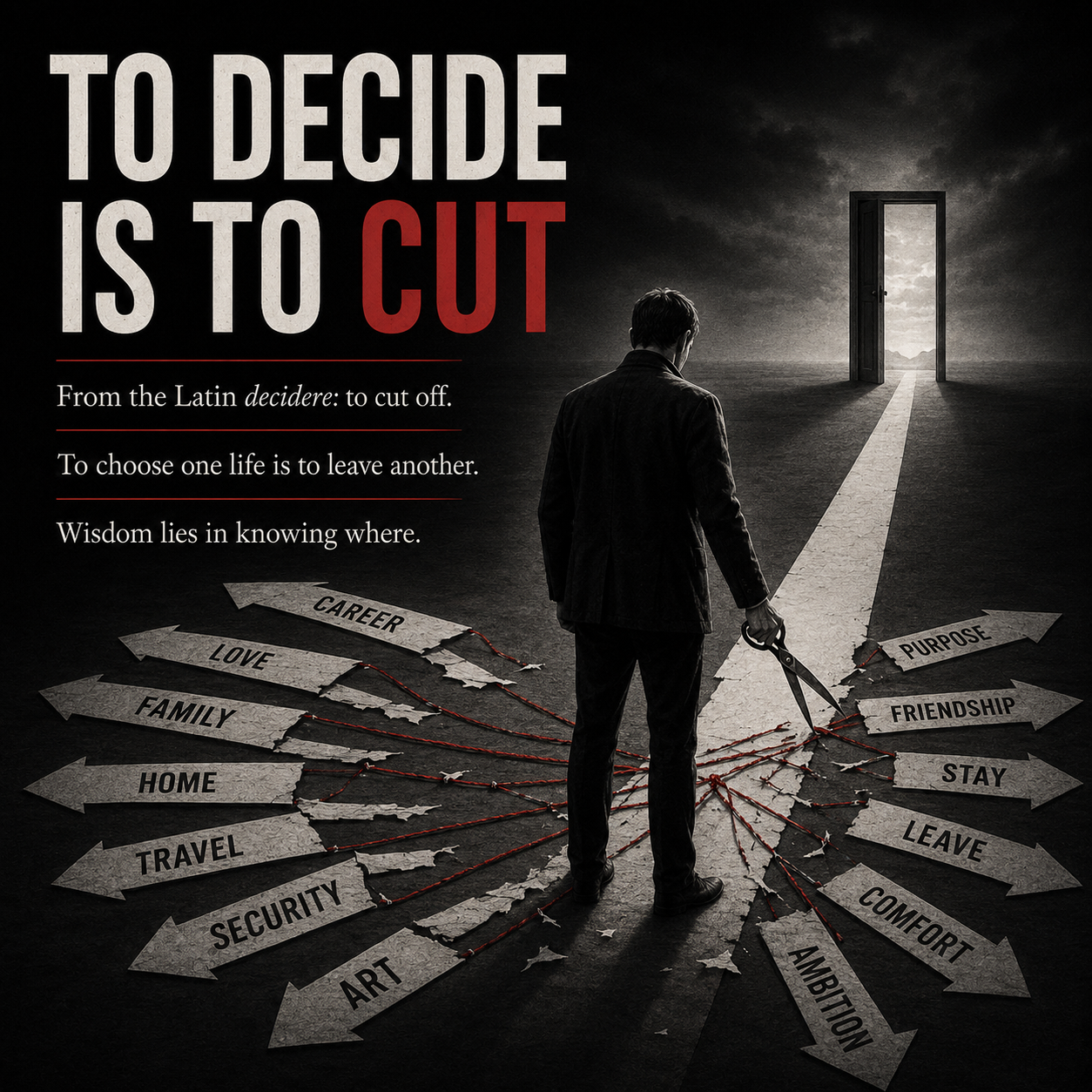
The Life We Leave Behind
