

Influence: Why We Say Yes Before We Think
Robert Cialdini’s Influence: The Psychology of Persuasion begins with a simple question:
Why do people say yes? The answer is not always reason.
We like to believe that we examine the facts, weigh the alternatives and make a deliberate choice. Sometimes we do.
Often, we take a shortcut.
Modern life gives us more information than we can properly examine. We therefore rely on familiar signals. These signals save time. They help us decide.
They also make us easier to influence.
Cialdini identifies six principles that guide many of our decisions: reciprocity, commitment and consistency, social proof, liking, authority and scarcity.
These principles are not tricks invented by salespeople but are normal parts of human behaviour. Society could not work without trust, cooperation or respect for knowledge.
The danger begins when someone learns how to activate them without deserving our trust.
1. Reciprocity: the weight of a gift
When someone gives us something, we feel pressure to give something back.
This rule holds communities together. People help one another because they expect kindness to be returned.
But a gift can also create a debt we never chose.
A free sample, an unexpected favour or a small concession may appear generous. It may also make the next request harder to refuse.
The lesson is not to reject generosity. It is to separate the gift from the decision that follows.
Gratitude is good.
Obligation is different.
2. Commitment and consistency: prisoners of our own words
We want our actions to match what we have already said and done.
Once we take a position, we feel pressure to defend it. A small commitment can therefore become the first step towards a much larger one.
Consistency is usually a virtue. Without it, promises would mean little.
But consistency becomes dangerous when we continue simply because we have started. We defend an old decision even after the facts have changed. We protect our reputation at the expense of our judgement.
A foolish decision does not become wise because we have repeated it.
Changing our mind is not always weakness but it is evidence that we are still thinking.
3. Social proof: if everyone believes it, it must be true
When we are uncertain, we look at what other people are doing.
This is often sensible. A crowded restaurant may be good. A practice followed by experienced colleagues may have merit.
Yet a crowd can be confidently wrong.
Social proof is strongest when the situation is unclear and the people around us appear similar to us. This explains the power of testimonials, popularity figures, industry practice and phrases such as “everyone does it.”
But repetition is not evidence.
In organisations, social proof can turn a weak practice into an accepted one. Nobody questions it because nobody else appears to question it.
The crowd may offer information.
It cannot take responsibility for our decision.
4. Liking: the friendly thief
We are more easily persuaded by people we like.
We tend to like those who resemble us, praise us, cooperate with us or appear familiar. Physical attractiveness can also influence our judgement, even when appearance has nothing to do with the decision.
There is nothing wrong with liking people.
The mistake is to confuse liking the person with trusting the proposal.
A pleasant manner does not make a weak argument strong. A compliment does not improve the evidence. Friendship does not remove a conflict of interest.
Warmth deserves warmth.
Claims still require scrutiny.
5. Authority: the comfort of being told
We are trained to respect expertise and authority.
Usually, this serves us well. No individual can master every subject. We must depend on doctors, engineers, lawyers, auditors and other specialists.
The problem is that we often respond to the appearance of authority rather than its substance.
Titles, clothes, reputation and institutional status can silence questions before they are asked. We may obey the expert even when the expert is speaking outside their field.
Authority can guide judgement.
It should not replace it.
The right question is not simply, “Who said it?”
It is also, “What evidence supports it?”
6. Scarcity: the fear of losing
Things appear more valuable when they are difficult to obtain.
“Last chance.”
“Only two remaining.”
“Offer ends today.”
Scarcity creates urgency. Urgency reduces reflection. We begin to fear losing the opportunity more than we consider whether the opportunity is worth having.
Restrictions can also increase desire. When access to something is limited, we may want it simply because someone has told us we cannot have it.
Scarcity may be real.
But rarity is not the same as value.
Before acting, we should ask whether we want the thing itself—or merely fear losing it.
The deeper lesson
Cialdini’s six principles work because they are useful.
Reciprocity supports cooperation. Consistency supports trust. Social proof helps us navigate uncertainty. Liking builds relationships. Authority allows knowledge to be shared. Scarcity helps us notice limited resources.
The problem is not the shortcut.
The problem is using it without noticing.
Persuasion is most powerful when it feels like our own decision. We see the signal, follow the familiar rule and supply the justification afterwards.
We say yes first.
We explain later.
What this means for better decisions
Cialdini’s work belongs naturally within the study of practical wisdom.
Better decisions require more than information. They require an understanding of the forces acting upon our judgement.
Before an important decision, ask:
Am I returning a favour rather than judging the proposal?
Am I defending an earlier commitment?
Am I following the crowd because I am uncertain?
Am I persuaded by the person rather than the evidence?
Am I obeying a title or examining genuine expertise?
Am I acting because the opportunity is valuable—or because time is running out?
These questions do not make us immune to influence.
Nothing does.
But they create a pause between the trigger and the response. Inside that pause, judgement has a chance to return.
That may be the book’s most important lesson:
We cannot remove persuasion from human life.
But we can learn to see it before it decides for us.
Based on Robert B. Cialdini’s Influence: The Psychology of Persuasion.
The Phronesium perspective
At Phronesium, we study how people and organisations can make better decisions.
That means examining evidence, logic, ethics, risk and judgement. But it also means considering psychology.
Decisions are not made by machines. They are made by people.
People feel obligation. They follow crowds. They respect authority. They trust those they like. They defend earlier choices. They fear missing out.
Ignoring these forces does not make us rational. It merely makes their influence harder to see.
Cialdini’s principles therefore matter to Phronesium. They help us understand not only how people can be persuaded, but how judgement can be protected.
Better decisions require sound information.
They also require self-awareness.
Because before we can improve the way we decide, we must understand what is already deciding for us.
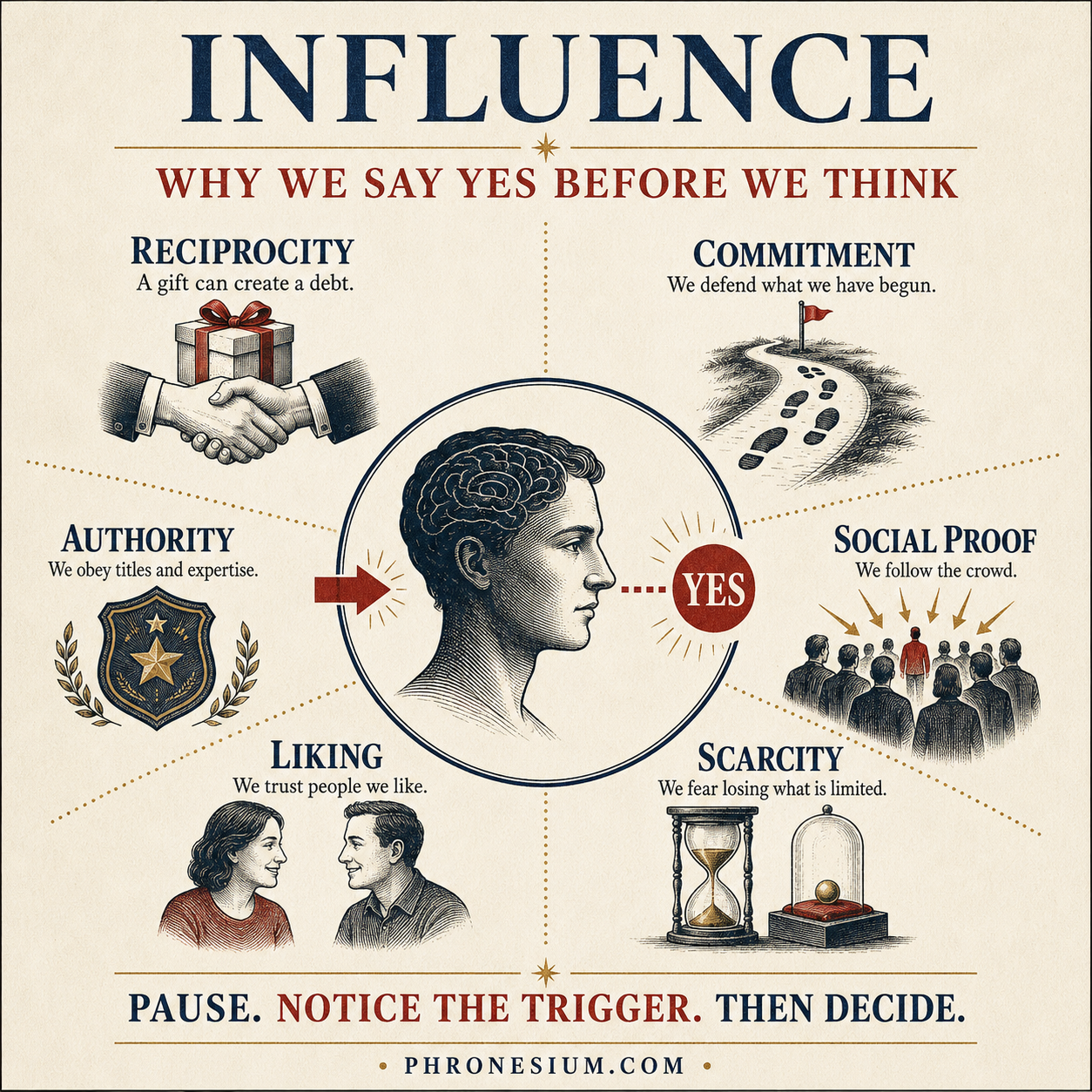
Six powerful forces that shape our choices: reciprocity, commitment, social proof, liking, authority and scarcity.
