

Better Decisions Begin with Better Relationships
Why Phronesium studies psychology as well as logic
Phronesium was founded around a simple ambition: to understand how people and organisations can make better decisions.
That means studying evidence, logic, judgement, risk and ethics.
But it also means studying people.
Decisions are rarely made in a quiet room by a perfectly rational mind. They are made in meetings, families, teams and organisations. They are shaped by trust, fear, pride, status, sympathy and the need to feel heard.
A decision may be analytically sound and still fail because the people involved do not understand it, trust it or feel part of it.
This is why Phronesium also considers psychological and interpersonal approaches to better decision-making. Among the most practical are the principles developed by Dale Carnegie inHow to Win Friends and Influence People.
First published in 1936, the book remains influential because it deals with something that has not changed very much: human nature. Official Dale Carnegie materials continue to present its teachings through 30 principles for relationships, influence and leadership.
Carnegie’s subject was not decision science in the modern sense. Yet his principles address an essential part of every important decision:
How do we think and act wisely when other people are involved?
Rationality is not enough
Traditional models often treat a decision as a choice between alternatives.
Identify the objective.
Collect the evidence.
Assess the risks.
Choose the best option.
This is necessary.
But it is incomplete.
People do not respond only to facts. They respond to how those facts are presented, who presents them and whether they feel respected during the process.
Criticism may provoke resistance. An order may invite compliance without commitment. An argument may be won while the relationship is lost.
Carnegie understood that influence begins with recognising the dignity of the other person.
His principles are therefore not tricks for controlling people. Properly understood, they are disciplines of attention, empathy and self-restraint.
They remind us that better decisions are not merely correct decisions.
They are decisions that people can understand, challenge, support and implement.
Carnegie’s 30 principles through the lens of better decisions
The wording below is Phronesium’s interpretation of Carnegie’s principles and their relevance to judgement, leadership and decision-making.
1. Begin by managing yourself
Before trying to change another person, examine your own conduct.
Avoid reflexive criticism. Criticism often makes people defensive before it makes them reflective.
Recognise genuine contribution. Honest appreciation helps people understand which behaviours should continue.
Connect the proposal to what others value. People act more willingly when they can see what the decision means for them.
These first principles contain an important lesson: influence does not begin with authority. It begins with self-control.
A leader who cannot manage irritation, ego or impatience will struggle to manage a decision well.
2. Build relationships before demanding agreement
Trust is not a decorative addition to decision-making. It is part of the infrastructure.
Take a sincere interest in people. Curiosity about others produces better information and stronger relationships.
Bring warmth into the conversation. A welcoming manner can reduce unnecessary tension.
Remember people as individuals. Names, responsibilities and personal context matter because people want to be recognised, not processed.
Listen more than you speak. Good decisions depend on information that leaders may not already possess.
Discuss what matters to the other person. Communication becomes clearer when it begins from the listener’s concerns.
Make people feel valued—and mean it. Respect must be real. False praise is manipulation, not leadership.
These principles challenge a common organisational habit.
We often prepare extensively for what we want to say, but very little for what we need to hear.
Listening is not passive. It is a method of gathering evidence.
Influence without unnecessary conflict
Disagreement is unavoidable. Humiliation is not.
Do not treat every disagreement as a contest. Winning an argument may make agreement less likely.
Respect the possibility that the other person may be right. Certainty should be proportional to the evidence.
Acknowledge your own errors promptly. Admitting mistakes protects credibility more effectively than defending the indefensible.
Start difficult conversations in a constructive spirit. The opening tone often shapes everything that follows.
Begin with areas of agreement. Shared ground makes differences easier to examine.
Give others room to explain their reasoning. A person cannot feel heard if the leader does all the talking.
Allow people to contribute to the solution. Participation creates ownership.
Try to see the decision from the other person’s position. Perspective-taking reveals risks that authority may conceal.
Recognise people’s concerns and aspirations. Empathy does not require agreement, but it does require understanding.
Connect decisions to worthy motives. People are often moved by fairness, responsibility, service and professional pride.
Make the idea vivid. A clear example or story can communicate consequences better than an abstract presentation.
Use challenge constructively. A meaningful challenge can awaken energy, courage and creativity.
This is not an argument for avoiding difficult decisions.
It is an argument for removing unnecessary conflict from them.
Strong leadership does not mean making others feel small. It means creating the conditions in which disagreement can produce insight rather than resentment.
Leadership after the decision
A decision is not complete when it is announced.
It is complete when it is understood and acted upon.
Begin feedback by recognising what is working. This establishes fairness before addressing weaknesses.
Correct without humiliating. Indirect or carefully framed feedback may preserve openness.
Acknowledge your own imperfections first. Leaders who admit their mistakes make it safer for others to examine theirs.
Ask questions instead of relying only on commands. Questions encourage judgement rather than mechanical obedience.
Protect the other person’s dignity. People should be able to change direction without being publicly diminished.
Recognise progress, not only final success. Improvement becomes more likely when it is noticed.
Express confidence in the person’s better qualities. People often try to live up to a reputation placed upon them.
Make improvement feel achievable. Encouragement turns correction into a path forward.
Help people feel positive about taking action. Implementation is stronger when people understand the purpose and retain a sense of agency.
These leadership principles are especially relevant when decisions involve change.
Change often threatens competence, identity or status. People may appear to resist the decision when they are really resisting the way it makes them feel.
A wise leader does not ignore this psychological reality.
Nor does the leader surrender the decision to it.
The task is to combine clarity with humanity.
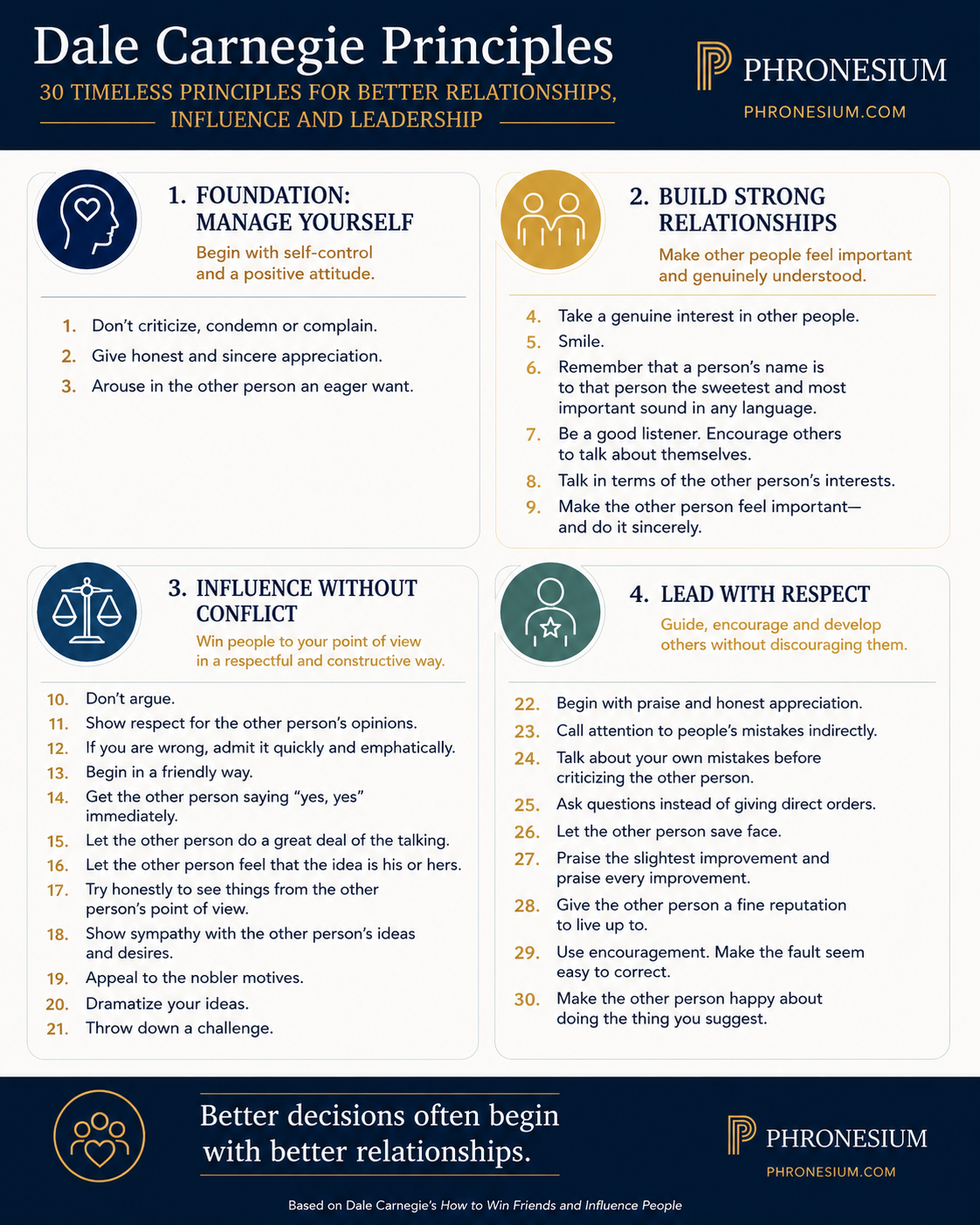
30 Timeless Principles
Carnegie, ethics and the danger of manipulation
The word influence can create discomfort.
It can suggest persuasion without consent, friendliness used as a technique or praise offered only to obtain compliance.
That is not the interpretation Phronesium adopts.
Influence becomes manipulation when it conceals its true purpose, exploits vulnerability or treats people merely as instruments.
Ethical influence is different.
It respects autonomy.
It tells the truth.
It listens seriously.
It allows disagreement.
It seeks cooperation without removing choice.
Carnegie’s principles work only when sincerity is present. Without sincerity, remembering a name becomes a tactic. Listening becomes performance. Appreciation becomes flattery.
The method may look the same from a distance.
The intention is entirely different.
This is why psychology must be studied alongside ethics.
The question is not only:
Does this approach influence people?
It is also:
Is the influence honest, proportionate and respectful?
A broader model of better decisions
At Phronesium, we believe that decision quality has several dimensions.
A good decision should be:
supported by credible evidence;
reached through sound reasoning;
conscious of uncertainty and risk;
ethically defensible;
communicated clearly;
informed by the perspectives of those affected;
capable of being implemented in the real world.
Carnegie’s work strengthens the final three.
He reminds us that decisions travel through human relationships.
A strategy travels through conversations.
A control travels through behaviour.
A recommendation travels through trust.
A change programme travels through thousands of personal reactions.
Ignoring psychology does not make a decision more rational.
It merely makes our analysis less complete.
The human side of practical wisdom
The name Phronesium comes from phronesis: practical wisdom.
Practical wisdom is not abstract intelligence. It is the ability to judge what should be done in a particular situation, among particular people, at a particular time.
That requires more than knowing the correct principle.
It requires knowing how to apply it without losing sight of the people involved.
Dale Carnegie’s rules do not replace evidence, analysis or courage. They help those qualities become effective.
A leader still needs to say no.
An auditor still needs to challenge.
A board still needs to make difficult choices.
But firmness does not require hostility. Challenge does not require humiliation. Authority does not require indifference.
Better decisions begin with better thinking.
But they often become possible through better relationships.
That is why Phronesium will continue to study both.
as taken from the book.
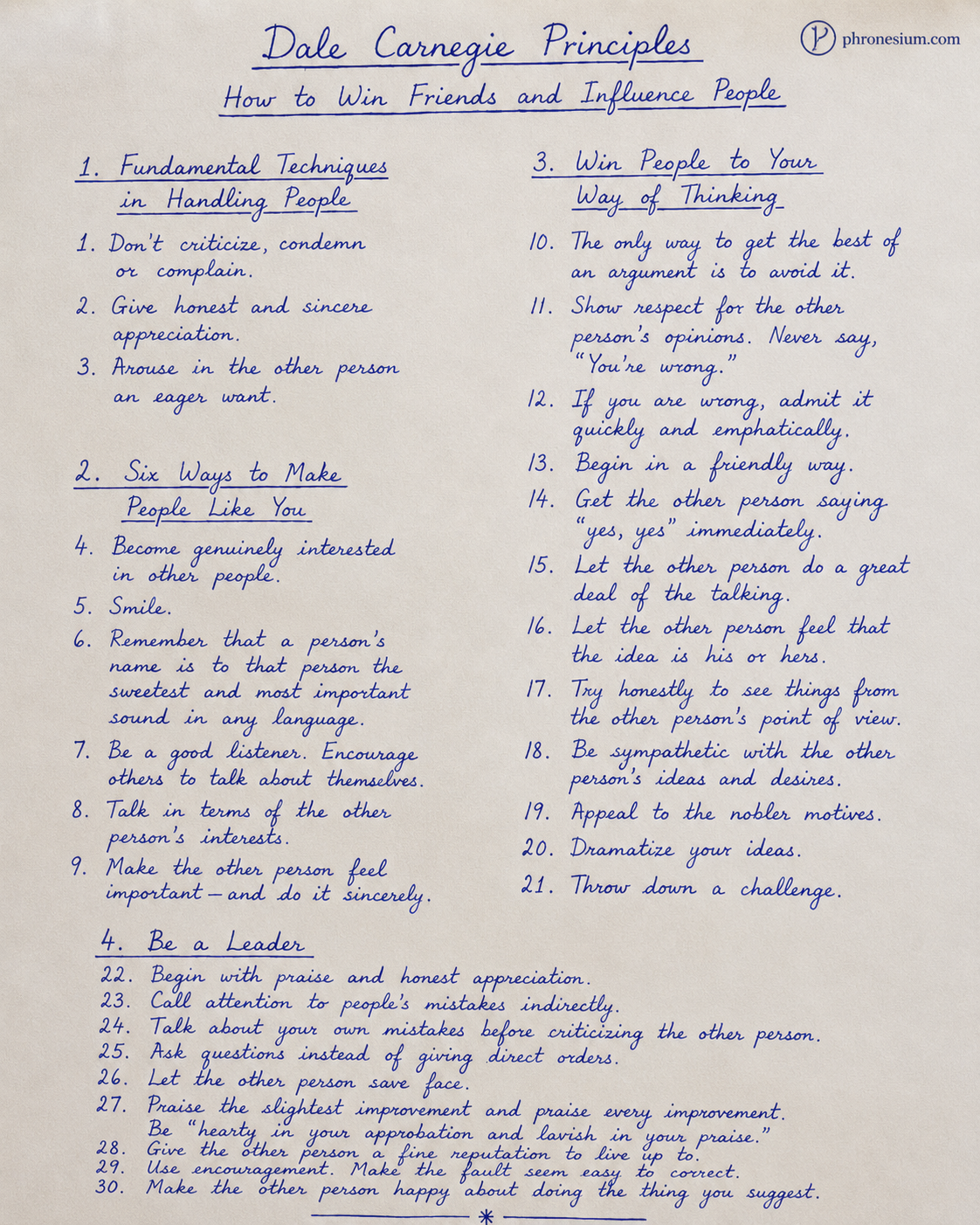
The Human Side of Better Decisions
