

Policies Do Not Audit. People Do.
What the FRC’s 2026 review reveals about audit quality, judgement and recurring failure.
The Financial Reporting Council’s Annual Review of Audit Quality 2026 contains both good news and an old warning.
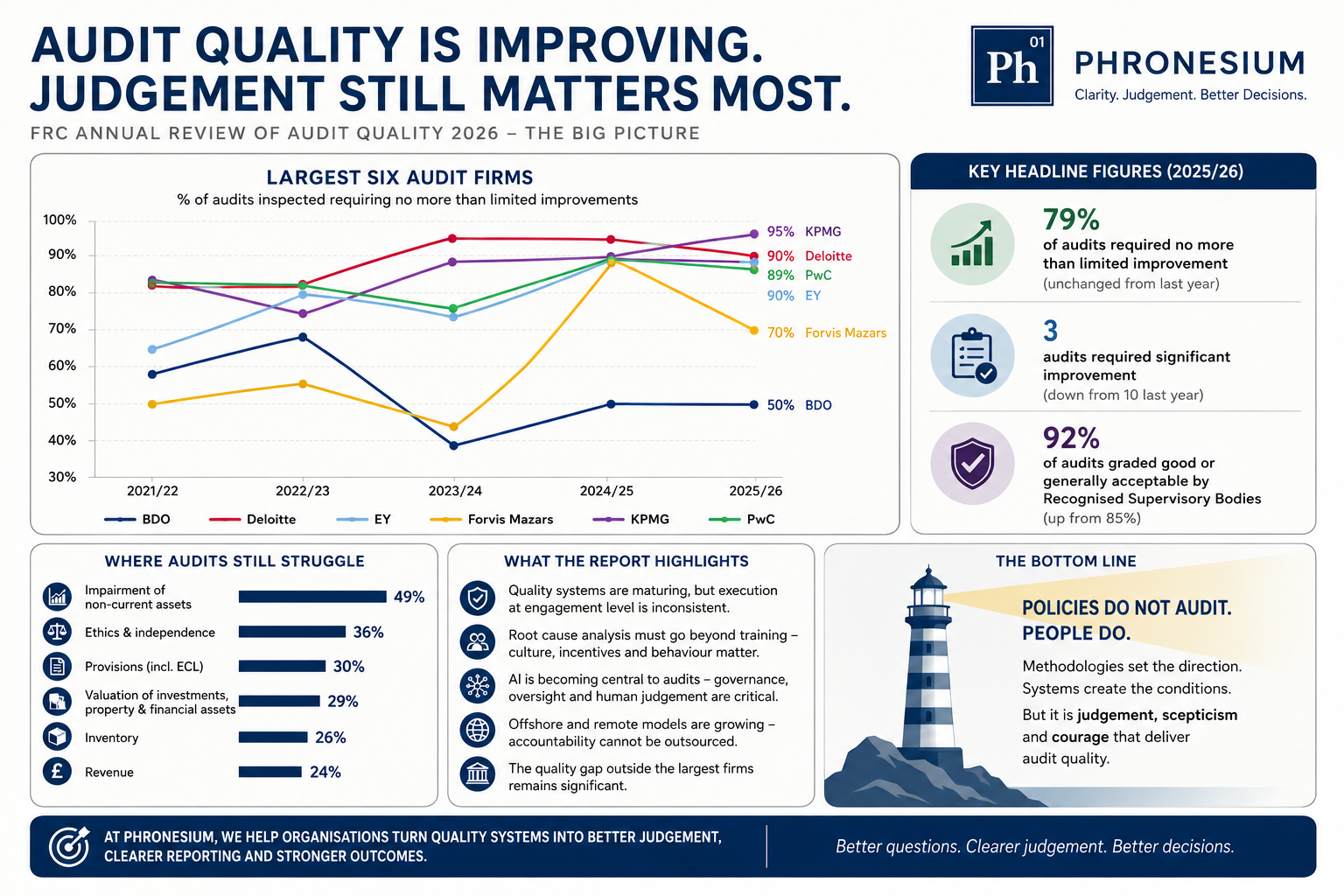
The good news is that fewer audits were judged seriously deficient. Of the 116 audits inspected, only three required significant improvement, compared with ten in the previous year.
The less comfortable news is that the overall result barely moved.
Seventy-nine per cent of audits required no more than limited improvement. The same figure as last year.
Progress, therefore, but not quite a revolution.
Audit Quality Is Rising. Judgement Still Matters Most.
Good news, but not enough for celebration.
Audit quality is improving, and the worst failures are fewer. Yet the same weaknesses remain, and results still vary sharply between firms. The message is plain: policies help, systems matter, and technology may assist. But none of them can question management, resist pressure or recognise a convenient answer. People must do that.
This is why the report matters to Phronesium.
Our work is to help organisations move beyond process—to think more clearly, judge more carefully and make better decisions.
Better systems, uneven results
The largest audit firms now generally have more mature Systems of Quality Management. Governance is stronger. Monitoring is more structured. Root-cause analysis is improving. Remediation plans are longer, more detailed and usually presented in reassuring colours.
Yet the quality of individual audits remains inconsistent.
This is the central message of the report.
A firm may have an excellent methodology, a sophisticated quality framework and a committee for almost every conceivable purpose. None of these things, by themselves, performs an audit.
Policies do not challenge management.
Frameworks do not exercise professional scepticism.
Templates do not ask the awkward second question.
People do.
The real test of a quality system is not whether it exists, but whether it changes what auditors do when the evidence is incomplete, the deadline is close and the answer from management is pleasantly convenient.
The familiar problems remain
The most common inspection findings arose in areas auditors know well.
Impairment of non-current assets produced findings in almost half of the relevant inspections. Ethics and independence, provisions, valuations, inventory and revenue also remained prominent.
These are not newly discovered territories.
Impairment, revenue recognition and valuation have occupied auditors for decades. They continue to cause difficulty because they depend heavily on assumptions, estimates and management judgement.
The technical rules matter. But the recurring weakness is often more basic: insufficient challenge, weak evidence or a conclusion reached slightly earlier than the facts justified.
Modern auditing has no shortage of guidance.
What it sometimes lacks is the courage to remain uncertain for a little longer.
The gap between firms
The largest firms generally performed better than the rest of the market, although results varied considerably.
KPMG, Deloitte, EY and PwC recorded strong inspection outcomes. Forvis Mazars showed improvement but still had work to do. BDO’s results remained a serious concern, with only half of the audits inspected requiring no more than limited improvement.
Outside the largest firms, the quality gap remains substantial.
This matters because competition in the audit market cannot be strengthened simply by adding more firms to a list. Capacity without quality is merely a larger problem.
Smaller and mid-market firms need investment, technical support and stronger quality systems. But they also need something less easily purchased: a culture in which difficult questions are rewarded rather than quietly postponed.
Root causes must go beyond training
The FRC continues to emphasise root-cause analysis.
This is welcome.
Too many quality failures are followed by the same remedy: more training, another checklist and a reminder to complete the checklist properly.
Training is useful when people do not know what to do.
It is less useful when they knew what to do but lacked time, confidence, supervision or willingness to do it.
The real causes of poor audit quality may include workload, commercial pressure, weak accountability, insufficient partner involvement or reluctance to challenge an important client.
These causes are less comfortable than “knowledge gap”.
They are also more useful.
A root-cause analysis that avoids culture, incentives and behaviour may be thorough in appearance and shallow in effect.
Artificial intelligence enters the audit file
The report also recognises the growing use of generative artificial intelligence in audit work.
AI may help auditors analyse information, prepare documentation and identify unusual patterns. It may also produce confident nonsense at impressive speed.
The correct response is neither panic nor blind enthusiasm.
Firms will need proper governance, testing, monitoring and human oversight. Auditors must understand how AI tools reach their conclusions and when those conclusions should not be trusted.
The great irony is that greater automation may make human judgement more important.
As machines produce more answers, auditors will need to become better at asking whether the answer makes sense.
Curiosity, scepticism and the ability to explore uncertainty are no longer soft skills. They are quality controls.
The lesson for audit committees
Audit committees should look beyond headline inspection percentages.
A useful conversation with an audit firm should include:
recurring inspection findings;
the genuine causes of those findings;
evidence that remediation has changed behaviour;
supervision of offshore and remote teams;
governance over AI-enabled audit work;
independence risks across international networks.
The question is not simply whether the firm has a quality programme.
The question is whether the programme works when the audit becomes difficult.
Make it stand out
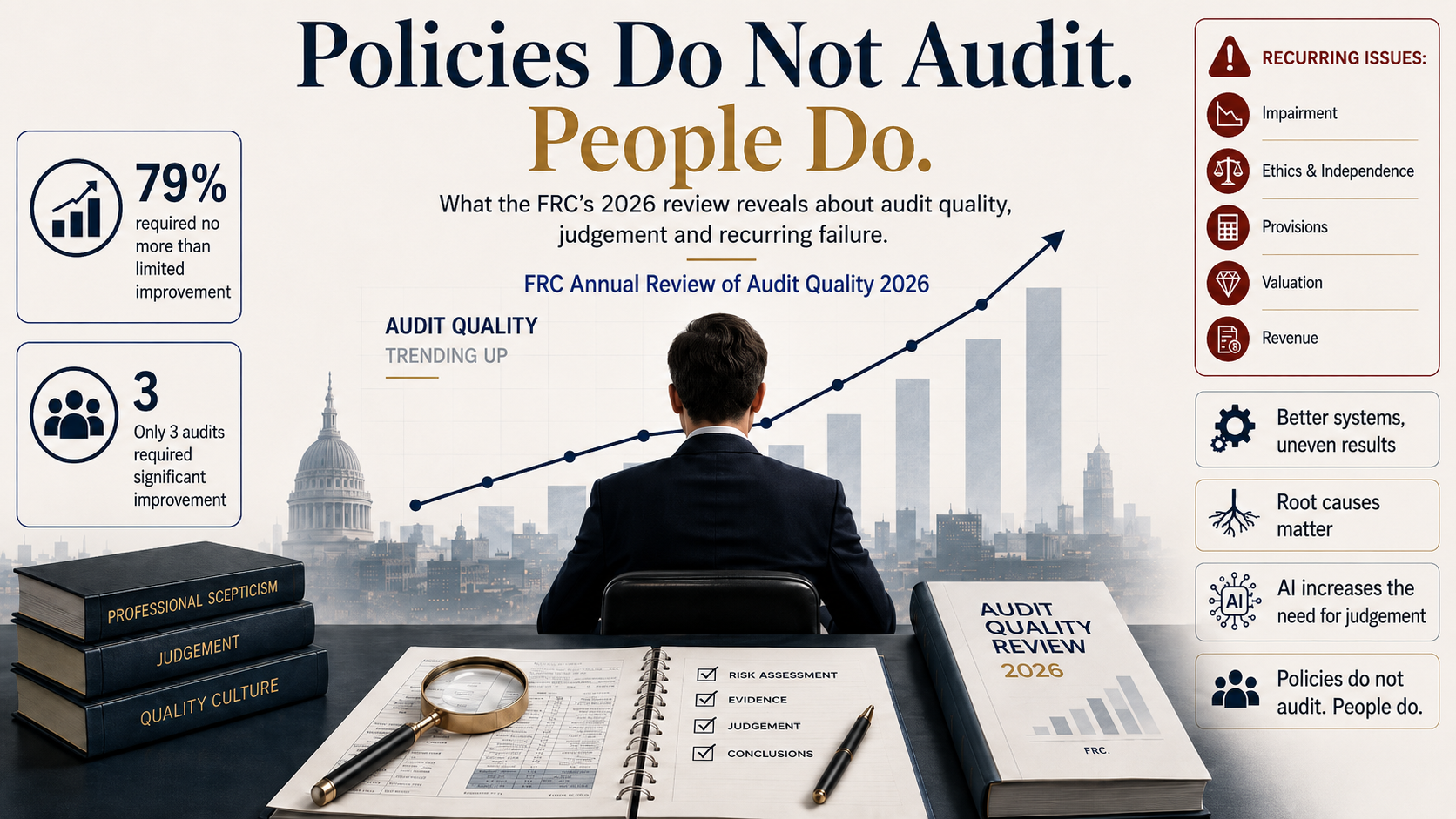
This image captures the central lesson of the FRC’s 2026 review: audit quality is improving, but policies and procedures alone do not produce a good audit.
The rising graph reflects stronger results. The reports, checklists and quality frameworks show the systems built to support auditors. Yet the person at the centre remains the most important control.
Professional scepticism, sound judgement and the courage to challenge cannot be delegated to a manual.
Policies support the audit. People make it work.
From compliance to judgement
The FRC’s review is cautiously encouraging.
Serious failures have reduced. Quality systems are becoming more mature. Several firms are achieving strong results.
But the enduring lesson is that audit quality cannot be manufactured through procedure alone.
A methodology can describe professional scepticism. It cannot supply it.
A policy can require challenge. It cannot make challenge comfortable.
A quality system can create the conditions for good judgement. It cannot replace judgement.
At Phronesium, we believe good governance begins with good judgement.
The FRC’s report offers the same reminder.
The future of audit quality will not be decided by who has the longest manual, the cleverest technology or the largest remediation plan.
It will be decided by whether auditors continue asking questions after everyone else is ready to stop.
