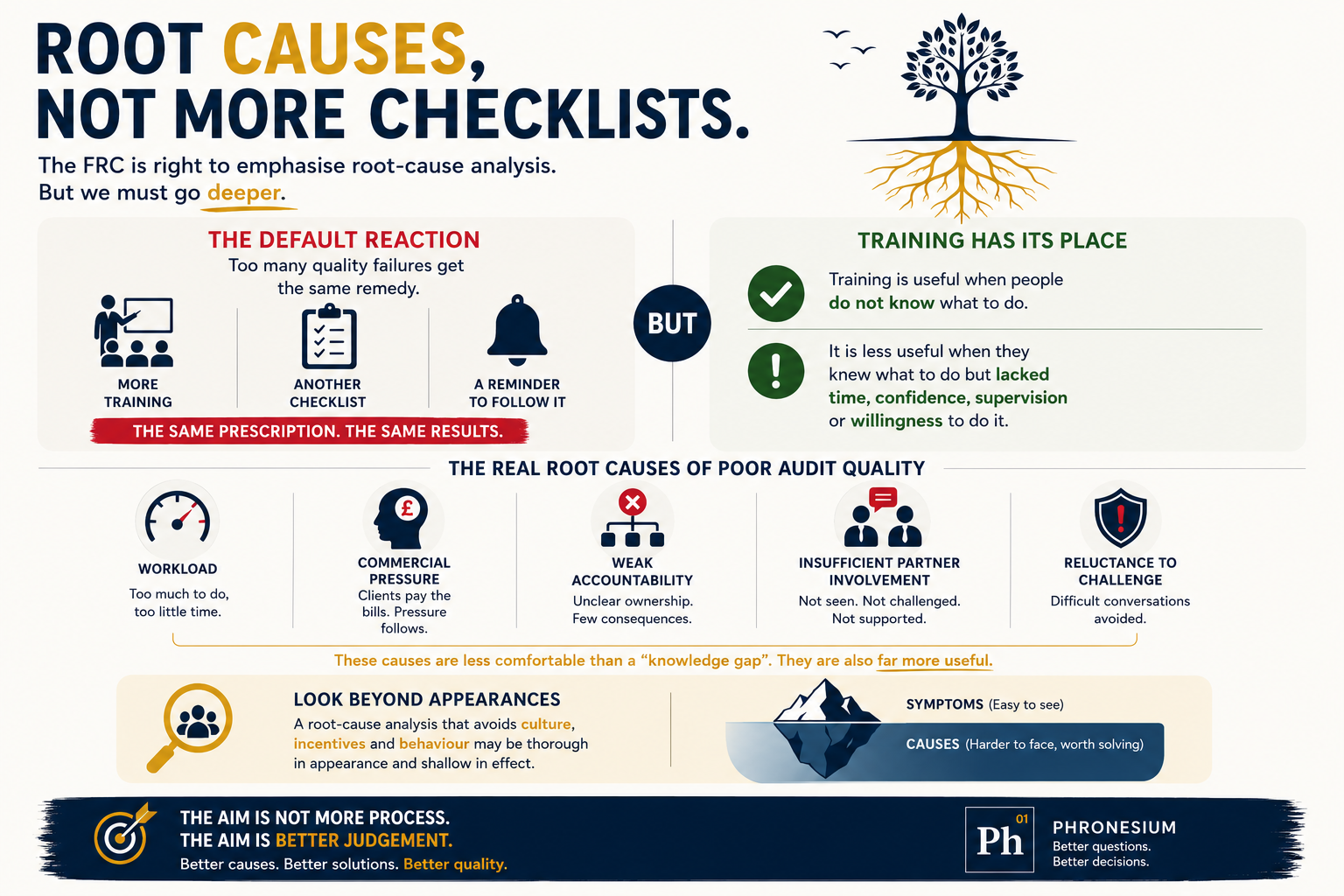
Root Causes, Not More Checklists
The FRC’s latest Annual Review of Audit Quality contains a lesson that should sound familiar.
When audit quality fails, the standard response is often predictable:
More training.
Another checklist.
A reminder to complete the checklist properly.
Then everyone returns to work, comforted by the knowledge that something has been done.
The difficulty is that activity is not the same as improvement.
Training is useful when people do not know what to do. But many audit failures do not arise from ignorance. They arise because people knew what to do and still could not—or would not—do it.
Perhaps the team lacked time.
Perhaps commercial pressure softened the challenge.
Perhaps accountability was unclear.
Perhaps the partner became involved too late.
Perhaps nobody wanted to ask an important client an inconvenient question.
These explanations are less comfortable than a “knowledge gap”. They are also more useful.
The problem beneath the problem
The FRC is right to emphasise root-cause analysis.
A genuine root-cause review should not stop at the first plausible explanation. “The auditor failed to challenge management” is a finding, not necessarily a cause.
The next questions matter more:
Why was the challenge weak?
Was the team overloaded?
Did the timetable allow proper reflection?
Was the partner sufficiently involved?
Were people rewarded for scepticism—or for keeping the audit moving?
Did the culture support challenge when challenge became commercially awkward?
The visible failure is often only the top of the iceberg. Beneath it sit workload, incentives, supervision, accountability and behaviour.
These are harder to record in a neat spreadsheet.
Unfortunately, they are usually where the answer lives.
Training has its place
None of this means training is unimportant.
Good training builds knowledge, confidence and professional capability. But training should not become the universal medicine prescribed for every organisational illness.
A course cannot repair an impossible workload.
A checklist cannot create courage.
A reminder cannot replace accountability.
And another page in the methodology will not help if people already understand the requirement but feel unable to apply it.
When every failure produces the same remedy, the organisation may not be conducting root-cause analysis. It may simply be repeating a ritual.
Look beyond appearances
A root-cause process can appear impressive while achieving very little.
It may contain interviews, diagrams, categories, action plans and deadlines. Yet if it avoids culture, incentives and behaviour, it may be thorough in appearance and shallow in effect.
The purpose is not to create a more elaborate explanation of failure.
The purpose is to prevent the failure from returning.
That requires honesty about how work is really performed—not merely how the methodology says it should be performed.
Why this matters to Phronesium
This is central to the Phronesium mission.
We help organisations move beyond the appearance of control and examine whether their systems produce clear thinking, sound judgement and better outcomes.
The question is not:
Have we delivered more training?
The better question is:
What prevented good judgement when it mattered?
That is where meaningful improvement begins.
Because audit quality does not improve through more process alone.
It improves when organisations understand the pressures, behaviours and decisions beneath the result—and have the courage to address them.
Better causes. Better solutions. Better quality.
#AuditQuality #InternalAudit #RootCauseAnalysis #Governance #ProfessionalJudgement #FRC #Phronesium