

A Phronesium × PredictionLabs.ai conversation about artificial intelligence, confidentiality, cost and the decisions that matter.
Artificial intelligence promises to make businesses smarter. But before giving it everything we know, perhaps we should ask what we are giving away.
The most revealing question
Imagine a company preparing its next strategic move.
It has confidential forecasts, customer information, supplier contracts, pricing strategies and perhaps a few problems it would rather its competitors knew nothing about.
Now imagine feeding all that information into an AI system.
The answers could be impressive.
The AI might detect risks, identify patterns, challenge assumptions and uncover opportunities that even experienced managers have overlooked.
But one question deserves attention before the first document is uploaded.
Who else might have access to what we are telling it?
This was one of the questions behind a recent conversation between Phronesium and PredictionLabs.ai.
The discussion concerned a simple ambition: making artificial intelligence genuinely useful to organisations, without losing sight of the cost, confidentiality and judgement involved.
The opportunity is substantial.
So are the questions.
Intelligence comes at a price
Most organisations have become accustomed to purchasing software as a service.
AI is no different.
Many powerful AI systems are accessible through subscriptions or usage-based charges. For businesses experimenting with new technology, this can be an excellent arrangement.
Little initial investment. Rapid implementation. Access to sophisticated models.
But experiments have a habit of becoming operations.
Ten employees become a hundred. Occasional questions become thousands of daily interactions. A useful application becomes essential to how the organisation works.
And the bill changes accordingly.
This does not mean externally hosted AI is necessarily expensive. It means that the economics need to be understood.
A company should compare the full cost of competing approaches over several years, including implementation, usage, infrastructure, maintenance, security and technical support.
The cheapest AI solution to start using is not necessarily the cheapest to keep using.
Your confidential information is still confidential
There is another cost that may be harder to calculate.
Information.
Consider an auditor analysing sensitive findings. A pharmaceutical company reviewing unpublished research. A manufacturer examining a proprietary production process. Or a board discussing a possible acquisition.
In each case, AI could provide valuable assistance.
In each case, the information requires protection.
This does not mean commercial AI providers automatically misuse customer information. Major providers offer business services with contractual protections, security controls and commitments concerning the use of customer data for model training.
But not every AI product has the same conditions.
Not every user has the same configuration.
And preventing information from being used to train a general model is not the same as preventing its processing or retention.
There are questions about where data travels, who may access it, how long it remains stored and which controls apply.
These questions become particularly important when personal, commercially sensitive or legally privileged information is involved.
Confidentiality should be a design requirement. Not a hope expressed after pressing Enter.
What if the intelligence stayed inside?
This brings us to an alternative worth examining.
What if an organisation could commission an AI system designed around its own objectives, information and operational requirements?
One that operates within its own controlled infrastructure, rather than sending sensitive prompts and documents to an external AI provider for processing?
The underlying technology already makes such architectures possible.
Pretrained, open-weight language models can be deployed locally. They can be combined with carefully controlled access to internal documents and specialist predictive models developed for particular business problems.
It is not always necessary to train a large language model from scratch.
Sometimes the better approach is to allow the model to retrieve relevant information securely when answering a question.
For organisations with the right requirements, a locally deployed system could offer significant advantages:
Greater control over where sensitive information is processed and retained.
Reduced dependence on external AI services.
More predictable costs for certain workloads.
Models and analytical tools adapted to specific business needs.
The possibility of combining predictive analysis with natural-language explanations.
This is not a promise that local AI is automatically cheaper or safer.
Servers need electricity. Systems need maintenance. Models need testing. Access rights need controlling. Security failures can occur inside an organisation just as they can outside it.
And some locally deployed models may not match the capabilities of leading hosted systems.
The important point is that organisations have choices.
The cloud is not necessarily the problem. The absence of a considered decision can be.
Prediction is useful. Judgement is essential.
This is where the conversation with PredictionLabs.ai becomes particularly interesting.
PredictionLabs.ai specialises in the application of artificial intelligence, statistics, mathematics and financial modelling to predictive analytics and risk management.
Its work focuses on helping institutional investors identify opportunities, anticipate market developments and make more informed decisions.
Phronesium approaches the problem from another direction.
We are interested in what happens between information and action.
How do organisations distinguish facts from assumptions? How do they assess uncertainty? How do they challenge conclusions? And, ultimately, how do they make better decisions?
These perspectives could complement one another.
The possibility discussed is to explore a tailored AI Decision Intelligence platform, combining predictive analytics with generative AI and deploying the appropriate components within an organisation's own controlled environment.
For an industrial organisation, imagine a system that could analyse operational data, identify unusual trends, forecast potential problems and explain the evidence behind its conclusions.
A manager could ask why production costs were increasing.
A risk professional could examine emerging exposures.
An auditor could explore patterns across thousands of transactions.
The system could help each of them see something they might otherwise miss.
But it would not replace their responsibility to question the evidence.
This is the potential behind a deeper collaboration between Phronesium and PredictionLabs.ai, including the possibility of developing joint solutions for organisations seeking more control over their AI capabilities.
Not simply more artificial intelligence.
Better decision intelligence.
The danger of a convincing answer
Of course, keeping information confidential is only part of the problem.
An AI system can produce an answer that is clear, persuasive and completely wrong.
It may draw an incorrect inference from reliable data. It may overlook an important exception. It may reflect bias in the information it receives.
And it may express uncertainty with remarkable confidence.
That makes AI governance more than a matter of cybersecurity.
Organisations also need to consider data quality, model validation, access permissions, accountability, monitoring and the ability to explain or challenge important conclusions.
A locally deployed system does not remove these responsibilities.
It brings more of them under the organisation's direct control.
The distinction matters.
Owning the technology does not guarantee owning the truth.
We should also be careful about what we ask artificial intelligence to do.
Predicting what might happen is not the same as deciding what ought to happen.
One concerns probabilities.
The other requires judgement, values, consequences and responsibility.
An algorithm may estimate the financial benefit of closing a factory.
It cannot, by calculation alone, decide what that closure should mean for the people who work there.
That remains a human decision.
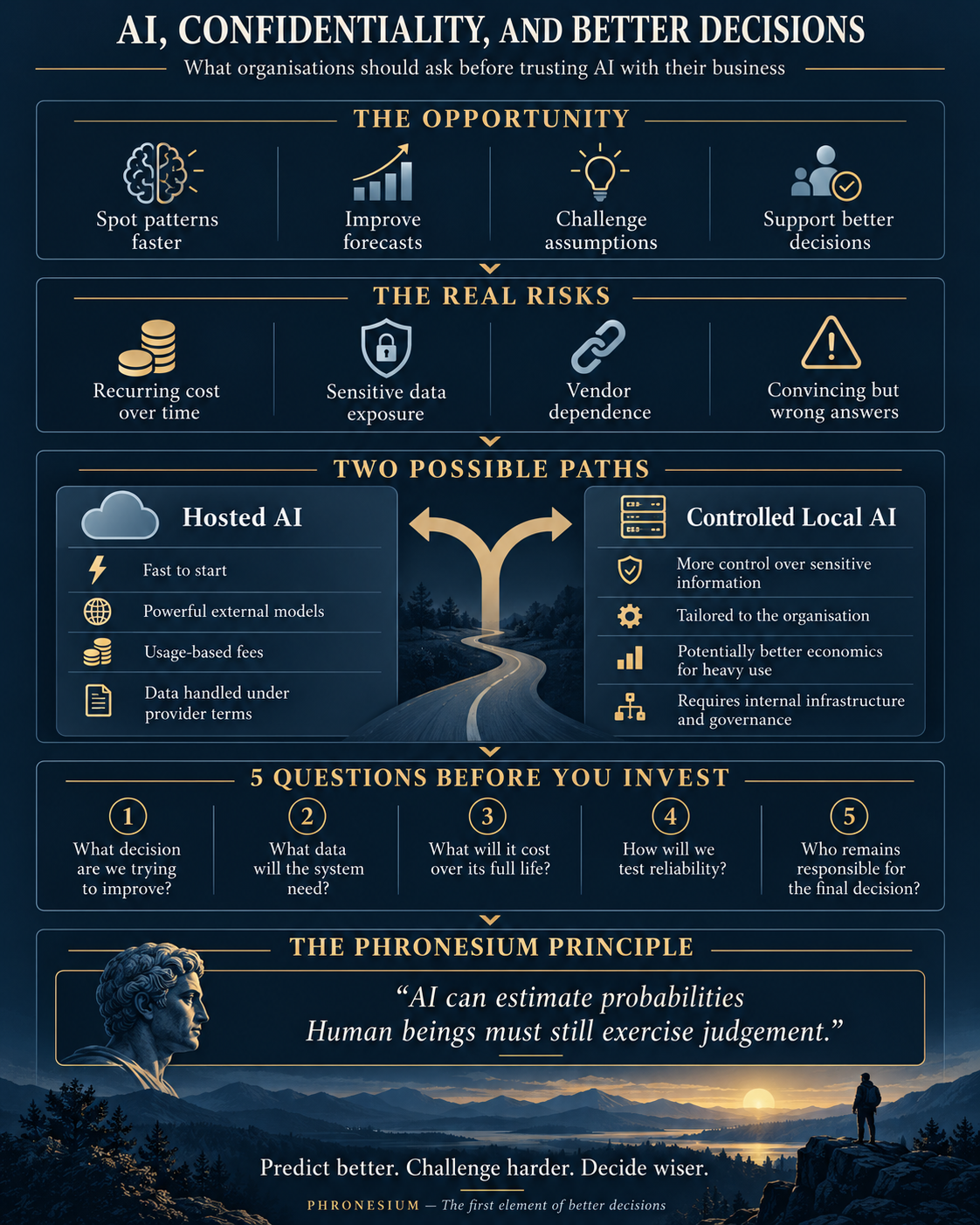
Five questions before investing in AI
Before committing to an AI platform, whether hosted, private or locally deployed, we would encourage decision-makers to ask five questions.
1. What decision are we trying to improve?
Not what technology do we want to buy. What problem are we trying to solve?
2. What information will the system need?
And how sensitive is it? Who is allowed to access it? Where can it be processed?
3. What will it cost over its useful life?
Include infrastructure, usage, people, maintenance and changes.
4. How will we know whether its conclusions are reliable?
What evidence supports the outputs? How are errors identified? Can users challenge the model?
5. Who remains responsible for the final decision?
If the answer is unclear, the governance is not ready.
These are not questions designed to slow innovation.
They are questions designed to make innovation worthwhile.
A more intelligent future requires better questions
Artificial intelligence will undoubtedly change how organisations analyse information, manage risks and make decisions.
Some will gain enormous advantages.
Others may invest heavily in systems they do not understand, exposing information they should have protected and automating processes that were poorly designed in the first place.
The difference will not be determined by technology alone.
It will depend on the quality of the questions organisations ask before choosing that technology.
Our conversation with PredictionLabs.ai opened an interesting possibility: bringing together advanced predictive capabilities, controlled AI deployment and the discipline of sound professional judgement.
It is an opportunity worth exploring.
Not because every organisation needs its own AI platform.
But because every organisation needs to understand the choices available to it.
Predict better. Challenge harder. Decide wiser.
And remember:
Artificial intelligence should improve human judgement. Not provide an excuse to stop using it.
Phronesium explores the relationship between knowledge, judgement and better decisions. Our conversation with PredictionLabs.ai forms part of an ongoing exploration of how tailored AI and predictive technologies could help organisations make better decisions while maintaining appropriate control over their information.
A final question for our readers:
If your organisation could build an AI system that understands its business without sending its most sensitive information to an external provider, what would you want that system to help you decide?
