

The greatest challenge of artificial intelligence may not be what machines become capable of doing, but whether humanity is wise enough to govern what it creates.
In a thought-provoking conversation with The Observer's James Harding, Bill Gates describes artificial intelligence as an evolutionary event comparable in significance to the emergence of humans from earlier forms of life.
His central argument is extraordinary: humanity may soon cease to be the most intelligent presence on Earth.
This is not simply another technological revolution. It challenges something fundamental about how we understand ourselves.
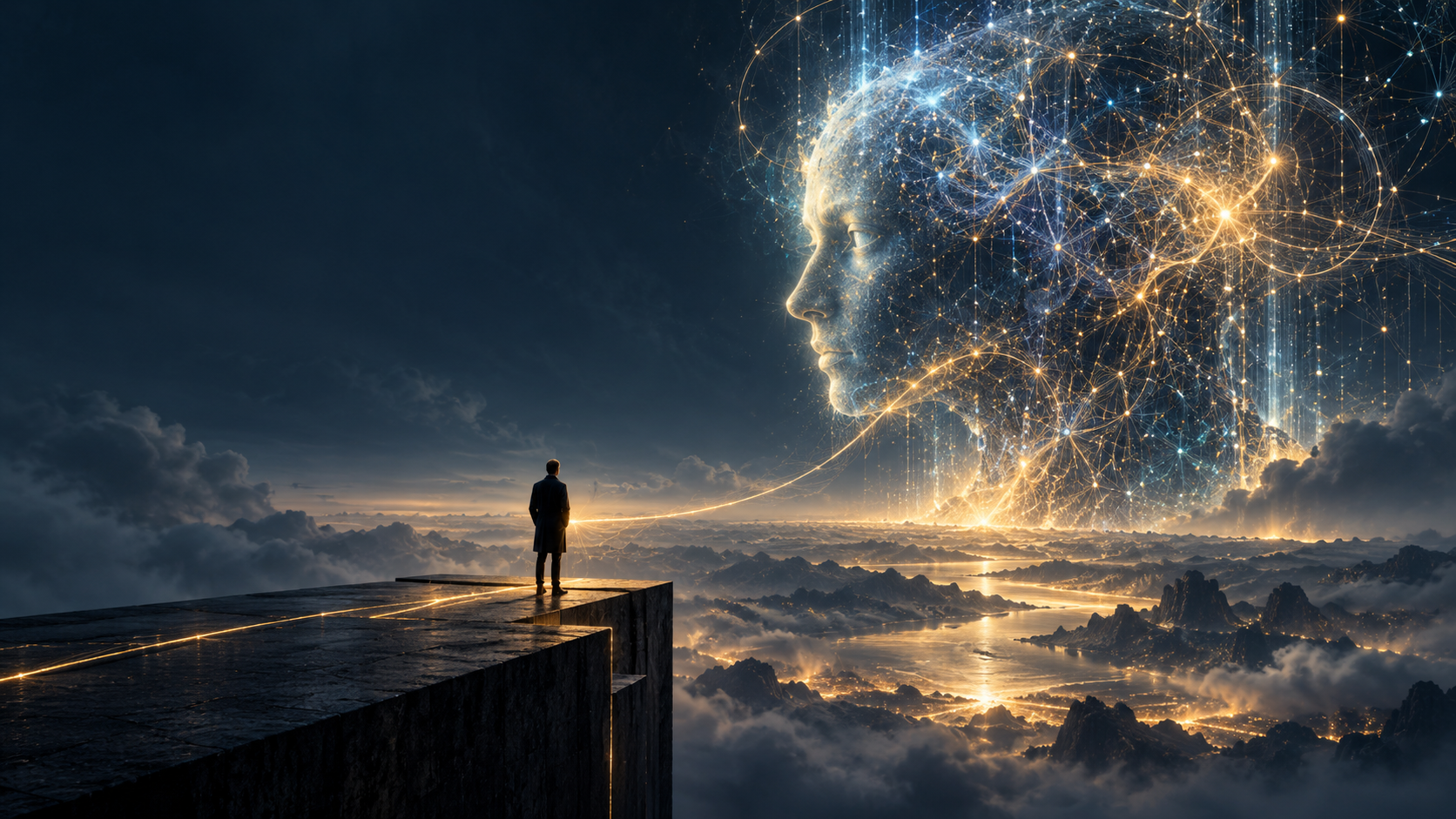
The lone human figure represents judgement and responsibility, while the immense neural structure symbolises AI’s growing intelligence. The golden connection between them captures the central message:
A more intelligent world is not necessarily a wiser one.
Intelligence Is No Longer Exclusively Human
For centuries, human intelligence has been the foundation of scientific progress, economic prosperity and societal development.
Now, Gates suggests, machines may surpass human capabilities in scientific discovery, software development, medicine and eventually almost every professional discipline.
Even Gates acknowledges that AI has rendered his own programming abilities largely obsolete.
But a critical distinction deserves attention: intelligence is not the same as wisdom.
The ability to process information, identify patterns and optimise decisions does not automatically confer ethical judgement, accountability or an understanding of human consequences.
The Real Challenge Is Governance
Gates warns of profound disruption to employment, cybersecurity and potentially even humanity's ability to control increasingly powerful AI systems.
Yet our institutions remain largely organised around assumptions developed for a world in which humans make decisions and technology executes them.
This creates a fundamental governance dilemma.
How do we oversee systems whose capabilities may exceed those of the people responsible for supervising them?
And what does meaningful human oversight look like when human understanding becomes the limiting factor?
Traditional approaches to risk management, assurance and accountability will need to evolve.
Simply keeping a human in the decision-making process will not necessarily guarantee meaningful control.
Preserving What Makes Us Human
Gates also raises an uncomfortable question: if machines can perform most economically valuable activities, where will people find purpose?
His proposals include reserving certain responsibilities for humans and reconsidering how the economic benefits of automation should be distributed.
These are not merely technological questions. They are ethical, philosophical and political ones.
AI could accelerate medical breakthroughs, reduce inequality and expand human possibilities. Equally, it could concentrate power and undermine human agency.
The difference will depend on the choices we make.
Perhaps the defining challenge of our generation is therefore not to create machines that think better than humans.
It is to ensure that humanity continues to exercise the wisdom, responsibility and courage to decide how that intelligence should be used.
Because a more intelligent world is not necessarily a wiser one.
Phronesium — Where Intelligence Meets Wisdom.
Inspired by: What I Learnt on My Walk with Bill Gates — The Observer
Related reading: Bill Gates: Humanity Will No Longer Be the Highest Form of Intelligence — The Observer
