

What Yuval Noah Harari, the face of Jesus, and the age of artificial intelligence teach us about better judgement.
PHRONESIUM — The First Element of Better Decisions
The most familiar face nobody has seen
Almost everyone recognises the face of Jesus Christ.
For nearly two thousand years, artists have painted it. Churches have displayed it. Books have reproduced it. Millions of people have grown up with an image so familiar that it seems almost historical.
Yet we have no verified portrait of Jesus made during his lifetime.
We do not know precisely what he looked like.
This is the remarkable example used by historian Yuval Noah Harari to explain a problem with the way we understand information.
There is an important distinction here. Religious paintings may communicate profound spiritual and cultural meaning. They were not necessarily intended to serve as historical records.
But the example raises an uncomfortable question.
How often do we confuse something familiar with something true?
A picture can be reproduced a million times without becoming more historically accurate.
A statement can be repeated by thousands of people without acquiring a single additional piece of evidence.
And an idea can become universally accepted without ever having been properly examined.
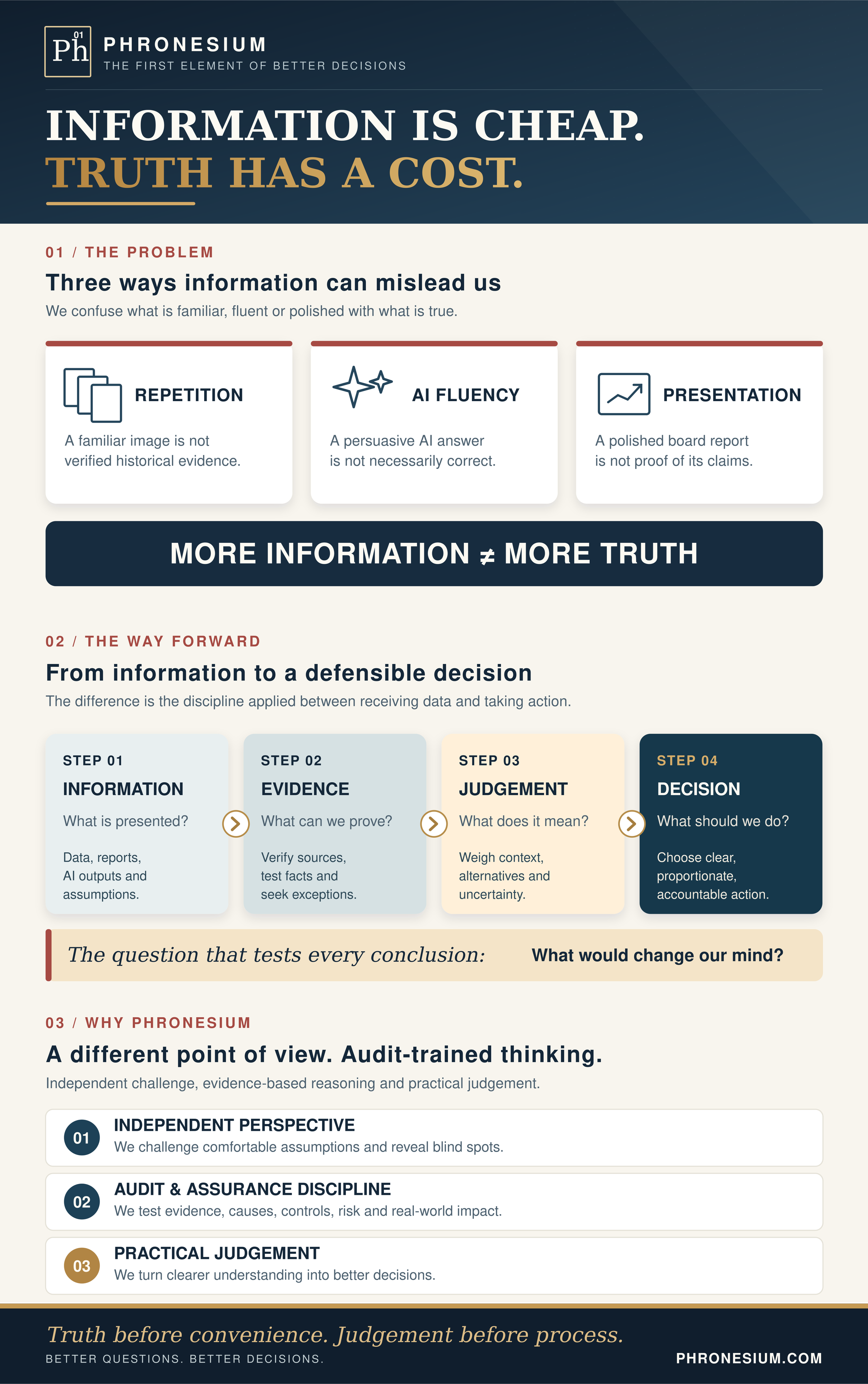
Recognition is not verification.
Neither is repetition.
More information does not mean more truth
We live in an age that measures progress partly by how much information we can produce, store and distribute.
We have more data, more reports, more research, more dashboards and more sophisticated technology than any previous generation.
Artificial intelligence can now produce in seconds what once required hours of human work.
We should be better informed than ever.
Perhaps we are.
But being better informed is not the same as understanding more. And understanding more does not necessarily mean making better decisions.
Harari challenges the assumption that increasing the quantity of information must eventually reveal the truth.
His argument is simple: truth is difficult and expensive to establish.
It requires evidence, research, verification, correction and time.
Inventing a convincing story requires considerably less.
This creates a problem.
The information that spreads most easily is not necessarily the information that is most reliable.
Sometimes it is simply the information that is most attractive, reassuring, frightening or convenient.
And convenience has always enjoyed a rather unhealthy advantage over truth.
The dangerous comfort of certainty
Consider an organisation preparing an important strategic decision.
Management produces a detailed report.
There are market forecasts, financial projections, performance indicators and risk assessments.
The presentation contains fifty slides.
The charts are impressive. The conclusions are confident. The recommendations appear reasonable.
Everyone has received the information.
But has anyone tested the assumptions?
Perhaps the growth forecast depends on an optimistic market scenario.
Perhaps the risk assessment relies on incomplete data.
Perhaps an important alternative was rejected before the analysis began.
Perhaps the figures are accurate but the conclusion is wrong.
There may be no deliberate deception.
The organisation may simply have mistaken a well-presented argument for a well-supported one.
A hundred pages of information cannot compensate for one untested assumption.
This is where judgement becomes essential.
Good judgement does not begin by asking how much information is available.
It begins by asking whether that information deserves our confidence.
When information becomes evidence
The distinction is particularly important in governance, risk management and internal audit.
An auditor receives a spreadsheet containing thousands of transactions.
That is information.
The auditor identifies twenty exceptions.
That is a finding from the analysis, but not yet a complete explanation of what happened.
Further examination establishes that fifteen exceptions resulted from a system configuration error, while five involved inconsistent application of an approval procedure.
Now the evidence begins to tell a more meaningful story.
But even then, judgement is needed.
What is the actual risk? How reliable is the evidence? Is the problem isolated or systemic? What would contradict the proposed conclusion?
These questions matter more than the number of transactions reviewed.
A finding supported by ten relevant, reliable pieces of evidence may be stronger than one accompanied by ten thousand poorly understood data points.
The same principle applies beyond auditing.
A board should distinguish a forecast from a fact.
A manager should distinguish a performance indicator from an explanation.
A researcher should distinguish correlation from causation.
And a decision-maker should distinguish confidence from certainty.
Information is what we receive. Evidence is what we can substantiate. Judgement is what we do with it.
The three are related.
They are not interchangeable.
Artificial intelligence has changed the scale. Not the principle.
AI makes Harari's argument particularly relevant.
For centuries, creating convincing text, images and explanations required human effort.
Today, software can produce them almost instantly.
An AI-generated report may be well structured, elegantly written and entirely persuasive.
It may also contain mistakes.
The danger is not simply that AI can produce false information.
People have been doing that for thousands of years, often without the assistance of technology.
The danger is that AI can produce plausible information at extraordinary speed and scale.
And plausibility is easily mistaken for credibility.
A confident explanation feels authoritative.
A polished document appears professional.
A precise number suggests accuracy.
None of these qualities establishes truth.
This does not make AI useless. Far from it.
AI can help people explore evidence, compare competing explanations, identify inconsistencies and challenge assumptions.
But its value depends on how it is used.
If we ask AI merely to confirm what we already believe, we have automated confirmation bias.
If we ask it to challenge our reasoning, we may improve the quality of our thinking.
The important question is not whether AI can provide an answer.
It is whether we can establish that the answer is worth trusting.
Reading is not the same as understanding
There is a useful connection here with Mortimer J. Adler and Charles Van Doren's How to Read a Book.
Their central lesson is that serious reading is an active exercise.
The reader must question the author, examine the argument, understand the evidence and eventually form an independent judgement.
This principle applies equally to books, news articles, management reports and AI-generated answers.
We should not merely consume information.
We should interrogate it.
Four questions provide an excellent starting point:
What is actually being claimed? Separate the central argument from the language surrounding it.
What evidence supports the claim? Establish where the information came from and whether it can be verified.
What might make the claim wrong? Look for missing information, competing explanations and evidence that challenges the conclusion.
Why does it matter? Determine what the information means for the decision at hand.
The third question is particularly important.
It is also the one people are often least enthusiastic about answering.
We enjoy evidence that confirms our opinions.
Evidence that threatens them is rather less welcome.
Yet the willingness to change one's mind is one of the clearest signs of sound judgement.
The real cost of truth
Harari argues that societies need institutions willing to invest in establishing the truth.
This includes research organisations, independent journalism and other mechanisms capable of examining evidence and correcting mistakes.
The same principle applies within organisations.
Reliable information does not arise automatically from collecting more data.
It requires sound methods, competent people, independent challenge and the freedom to report inconvenient conclusions.
It requires leaders who can distinguish between being informed and being reassured.
And it requires a culture in which correcting a mistake is treated as a sign of responsibility rather than an admission of weakness.
These things have a cost.
Independent assurance costs money.
Research takes time.
Professional scepticism can delay a decision.
Challenging an established view can make meetings uncomfortable.
But the alternative may be considerably more expensive.
Poor information produces poor understanding.
Poor understanding produces poor judgement.
And poor judgement can produce decisions whose consequences last for years.
The cost of establishing the truth is often visible.
The cost of ignoring it may remain hidden until it is too late.
Better decisions begin with better questions
Phronesium is built around a simple conviction.
Better decisions require more than information.
They require the ability to understand, question and judge what we know.
Aristotle called practical wisdom phronesis: the capacity to deliberate well about what should be done in particular circumstances.
It is not merely the possession of knowledge.
It concerns the intelligent application of knowledge, experience and judgement.
That distinction is particularly important today.
Technology continues to increase our capacity to produce information.
But technology alone cannot determine which questions deserve to be asked, which assumptions ought to be challenged or which consequences we should be willing to accept.
Those responsibilities remain central to human judgement.
We do not need to distrust everything.
Nor should we pretend that certainty is always possible.
We need to become more disciplined about the difference between what we know, what we believe and what we merely assume.
Because the problem is not that information is abundant.
The problem begins when abundance is mistaken for understanding.
And understanding is mistaken for wisdom.
One good question
What do you currently believe to be true because you have heard it repeatedly, rather than because you have examined the evidence?
Think of one important decision you have made recently.
Then ask yourself:
What evidence would have made me change my mind?
If you cannot answer, perhaps the decision deserves another look.
After all, the purpose of better thinking is not always to reach a different conclusion.
Sometimes it is to discover whether the conclusion we already hold deserves to survive.
TRUTH BEFORE CONVENIENCE.
PHRONESIUM — The First Element of Better Decisions
Sources and further reading
Yuval Noah Harari, Why Advanced Societies Fall for Mass Delusion, Big Think. The interview contains the passage on information, truth and artistic representations of Jesus.
Yuval Noah Harari, Nexus: A Brief History of Information Networks from the Stone Age to AI (2024).
Mortimer J. Adler and Charles Van Doren, How to Read a Book: The Classic Guide to Intelligent Reading.
