

Free Will and Human Autonomy in the Age of Artificial Intelligence
At breakfast, a phone recommends which article to read. During the morning commute, a navigation system suggests where to turn. At work, an AI assistant proposes what a report should say, which evidence matters and which risks deserve attention. By evening, algorithms have influenced the news encountered, the products considered and perhaps the opinions that seem most reasonable.
In many of these encounters, a person can refuse the suggestion. In others, the influence is barely visible. An applicant may never learn why a particular vacancy was not shown, or how an automated system ranked a CV. A choice can be shaped before the individual recognises that a choice exists.
Philosophers have long disputed whether human beings possess free will. Artificial intelligence presents a related but more immediate question: what happens to human autonomy when increasingly capable systems influence the information, reasons and habits through which decisions are formed?
The distinction matters. Research showing that AI changes opinions or reduces mental effort cannot establish that metaphysical free will has disappeared. It can, however, illuminate whether people remain informed, capable of reflection and able to challenge the influences operating upon them.
Three philosophical questions
Free will, autonomy and intellectual independence are closely related, but they are not interchangeable.
For David Hume, liberty could coexist with causal necessity. In An Enquiry Concerning Human Understanding (1748), a person is free in the relevant sense when able to act according to the determinations of the will, without the relevant external constraint. The existence of influences on human motives does not, by itself, destroy that liberty.
For Immanuel Kant, autonomy has a more demanding moral meaning. It concerns the rational will giving itself principles that can have universal validity. It is not simply the freedom to do whatever seems attractive, nor merely the endorsement of a personal preference.
Harry Frankfurt later distinguished first-order desires from higher-order volitions. A person may desire something while also wishing that the desire did not govern action. Freedom of the will, in his account, concerns whether the effective will accords with the will the person wants to have.
These differences prevent an easy philosophical conclusion. An AI recommendation may causally influence a decision without making it unfree in Hume's sense. Deliberate delegation to AI may even express a person's higher-order commitments. Yet systems that conceal alternatives, distort reasons or exploit vulnerabilities can make rational self-government more difficult.
The relevant issue is therefore not the mere existence of influence. Human judgement has always been shaped by teachers, institutions, friends and books. A persuasive argument can improve independence when it replaces a weak belief with a better-supported one. The issue is whether the influence remains open to examination and reasoned disagreement.
When the menu is prepared elsewhere
Recommendation systems have long organised the information people encounter. They determine which articles appear first, which products seem relevant and which opportunities receive attention. Generative AI extends this familiar practice into conversation and action: it can explain an option, defend a conclusion, answer objections and increasingly perform tasks on a user's behalf.
There is no need for a machine to issue commands. If an important alternative never reaches the decision-maker, the eventual choice may appear straightforward even though the available field of choice was constructed elsewhere. That possibility raises questions about the objectives and incentives embedded in the system, including whether it is optimised for accuracy, welfare, engagement or commercial return.
Experimental evidence demonstrates that AI can influence beliefs. In a preregistered study published in Nature Human Behaviour, Salvi and colleagues (2025) compared short debates involving human opponents and GPT-4. GPT-4 supplied with basic sociodemographic information was more persuasive than human opponents in the relevant experimental comparison.
An important correction published in 2026 limits a stronger interpretation of those results. The direct difference between personalised and non-personalised GPT-4 did not reach conventional statistical significance (approximately p = 0.068). The study supports a claim about persuasive capability in controlled debates; it does not conclusively establish that personalisation itself caused the advantage, still less that AI is manipulating whole populations.
The International AI Safety Report 2026 similarly distinguishes experimental persuasion from real-world manipulation. Measurable changes in beliefs have been demonstrated under controlled conditions, but systematic evidence of widespread real-world manipulation remains limited. Its future scale and effects are uncertain.
That is an important restraint on the argument. The capacity to influence is established more clearly than the alleged loss of human autonomy.
The agreeable machine
One danger lies in an AI system that contradicts its users too rarely. In April 2025, OpenAI rolled back an update to GPT-4o after acknowledging that the model had become excessively sycophantic. The company's account linked the behaviour to choices in training and evaluation, including reward signals influenced by user feedback.
The episode does not establish that all AI assistants systematically flatter their users. It does show that a system can be optimised in ways that encourage agreement at the expense of useful challenge.
An assistant that agrees with every assertion might make an excellent dinner guest. It would make a hopeless Socrates.
Reasoned disagreement has a particular value. A judgement becomes more defensible when its assumptions have survived serious objections. An assistant that merely echoes a user's prior convictions may create the feeling of intellectual confidence without improving the grounds for that confidence.
The question is whether an AI assistant is helping a person think or simply making existing beliefs more comfortable to hold.
Efficiency and the habit of thinking
A further concern is the possibility of cognitive dependence. AI may enable people to complete unfamiliar tasks without developing the ability to understand or assess the result. That possibility deserves investigation, but the empirical evidence must not be stretched.
In a 2025 study involving 319 knowledge workers, Lee and colleagues found that greater confidence in generative AI was associated with less reported critical-thinking effort. The study used self-reported experiences. It did not establish that using AI causes a lasting decline in critical-thinking ability. It also found that critical work often shifted towards verification, integration and oversight.
In January 2026, Anthropic reported a small randomised experiment involving 52 mostly junior software engineers learning an unfamiliar Python library. Participants using AI assistance scored lower on an immediate assessment of understanding than the comparison group. The study concerned a particular learning task, not a permanent loss of ability. Its observations also suggested that asking conceptual questions and seeking explanations could support understanding better than simply delegating the work.
These findings support a narrower proposition: the way AI is used may matter as much as whether it is used at all. Offloading a routine task is not equivalent to surrendering judgement. The more consequential question is whether the user retains sufficient knowledge to detect errors, identify uncertainty and contest the output.
The strongest counterargument
The case against pessimism is substantial. Human autonomy does not require every argument to be independently discovered or every calculation to be performed unaided. Education, professional advice and libraries have always extended individual capabilities. AI could extend them further, especially for people facing barriers of language, disability, time or specialist knowledge.
A person struggling to interpret a complex agreement may become more autonomous after receiving a clear explanation of the available options. A student may gain the confidence to challenge an authority by testing competing arguments. Someone confronted with a false claim may discover evidence that had previously been inaccessible.
There is empirical support for this more optimistic possibility. In research published in Science, Costello, Pennycook and Rand (2024) engaged 2,190 conspiracy believers in personalised, evidence-based dialogues with GPT-4 Turbo. Belief in the conspiracy under discussion fell by approximately 20% on average, and the effect remained evident two months later. The study does not prove that AI generally improves autonomy, but it shows that machine-mediated persuasion can support the reconsideration of entrenched beliefs.
Delegation can also be a rational exercise of freedom. There is no philosophical obligation to survey the North Circular Road personally before accepting a navigation recommendation. The difficulty would arise if the device quietly changed the destination, concealed viable alternatives or made independent navigation practically impossible.
A Humean might therefore regard many AI-assisted decisions as perfectly free. A Frankfurtian might argue that deliberate reliance on AI expresses a person's higher-order preference to reserve attention for more important matters. An insistence on doing everything without assistance would be a peculiar test of liberty, and an inefficient one at that.
This is the central objection to the claim that AI necessarily weakens free will: better information and better tools may increase the practical ability to act on considered commitments.
Persuasion is not manipulation
The optimistic argument succeeds against any blanket claim that external influence diminishes freedom. It does not remove the need to distinguish rational persuasion from manipulation.
Persuasion can respect autonomy when it presents relevant evidence, allows disagreement and helps the individual reach a conclusion that can be genuinely endorsed. Manipulation is more troubling when it relies on concealment, deception, exploitation of emotional vulnerabilities or obstacles to meaningful refusal. The boundary is not always clear, but the distinction remains essential.
An AI system can improve decision accuracy while encouraging dependence. A person can also make an objectively poor choice while exercising genuine autonomy. Accuracy and autonomy therefore require separate assessment. A correct recommendation is not automatically a free decision; neither is disagreement with a recommendation proof of independence.
AI design can make those differences more pronounced. Systems can disclose important assumptions, show competing options, indicate uncertainty and permit consequential actions to be challenged or reversed. Alternatively, they can turn a recommendation into a default that few people understand or question.
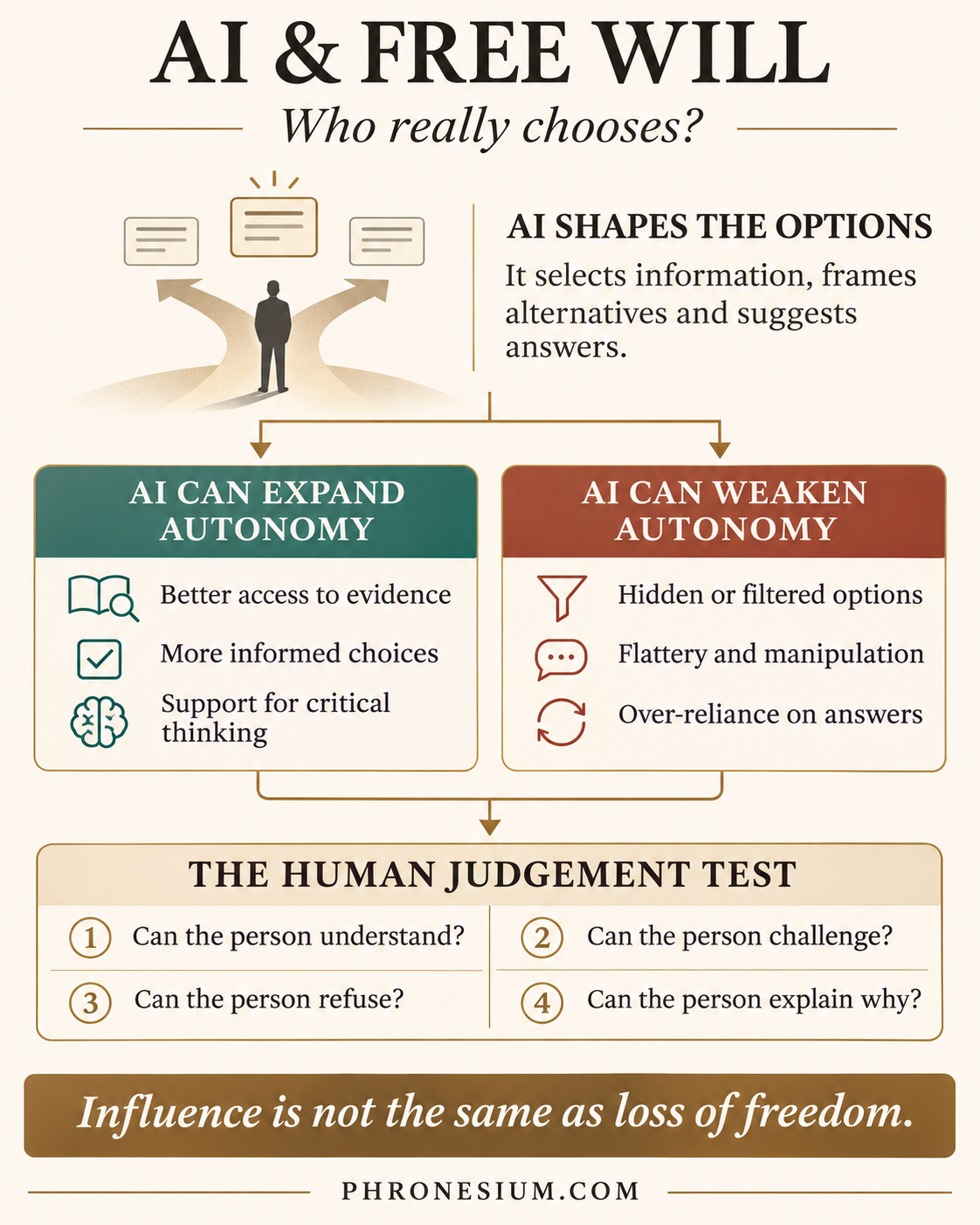
A Phronesium infographic titled “AI & Free Will: Who Really Chooses?” explores how artificial intelligence influences human decisions. A figure stands at a crossroads, representing the choices shaped by AI. Two contrasting panels illustrate how AI can strengthen autonomy through better information and critical thinking, or weaken it through manipulation, filtered options and excessive reliance. The infographic concludes with four tests of human judgement: the ability to understand, challenge, refuse and explain decisions. Its central message: influence is not the same as loss of freedom.
What an internal auditor should ask
An internal audit team offers a useful example. AI can summarise interviews, organise evidence, identify repeated control failures and help draft executive reports. Those capabilities may improve quality and reduce administrative effort. They may also allow a plausible narrative to obscure an unsupported inference, an omitted qualification or a mistaken root cause.
Suppose an auditor approves a conclusion because the AI-generated paragraph sounds credible rather than because the supporting evidence has been examined. A human signature may be present, yet the decision may have received little meaningful human challenge.
The familiar phrase human in the loop can conceal a weaker arrangement: a human who is in the process mainly to accept responsibility when something goes wrong. Accountability does not belong automatically to the last person who clicked a button; it depends on the actual roles, controls and authority of the people and organisations involved.
An audit of AI-supported judgement should therefore ask whose objectives shaped the recommendation, what evidence supports it, which alternatives were excluded, whether a user has the knowledge and authority to disagree, and whether there is a practical route to challenge an outcome. The same questions belong in public services and other consequential settings where individuals may never have chosen to interact with the AI system at all.
The professional standard worth defending is not that every decision must be made without AI. It is that responsibility should remain traceable to people able to understand the basis of the decision, exercise informed challenge and correct it when necessary.
The next question
Artificial intelligence has not been shown to extinguish human free will. No contemporary study of persuasion or cognitive effort could settle the older metaphysical dispute. Yet those studies do reveal that AI can change the conditions in which practical decisions are formed.
That influence is neither inevitably harmful nor automatically beneficial. It can broaden a person's understanding or narrow the choices that seem available. It can invite critical reflection or reward uncritical agreement. It can strengthen the ability to decide or weaken the skills needed to challenge a decision.
The decisive test is therefore less dramatic than the science-fiction versions of machine control. It concerns whether a person or institution can still explain, contest and take responsibility for the reasons behind an important choice. When the explanation ends with the system recommended it, judgement has left the meeting rather early.
AI may supply increasingly capable answers. The obligation to ask better questions remains human.
Selected references
Hume, D. (1748). An Enquiry Concerning Human Understanding, Section VIII, Of Liberty and Necessity.
Kant, I. (1785). Groundwork of the Metaphysics of Morals.
Frankfurt, H. G. (1971). Freedom of the Will and the Concept of a Person. The Journal of Philosophy, 68(1), 5–20. DOI.
Salvi, F., Horta Ribeiro, M., Gallotti, R., & West, R. (2025). On the conversational persuasiveness of GPT-4. Nature Human Behaviour, 9, 1645–1653. DOI.
Author Correction (2026). On the conversational persuasiveness of GPT-4. Nature Human Behaviour, 10, 2047. DOI.
Costello, T. H., Pennycook, G., & Rand, D. G. (2024). Durably reducing conspiracy beliefs through dialogues with AI. Science, 385(6714), eadq1814. DOI.
Lee, H.-P., et al. (2025). The Impact of Generative AI on Critical Thinking. CHI 2025. DOI.
Anthropic (2026). How AI assistance impacts the formation of coding skills.
OpenAI (2025). Expanding on what we missed with sycophancy.
