

Three lessons from the IIA's new guidance on auditing AI in banking
Phronesium | The First Element of Better Decisions
A bank uses artificial intelligence to assess a loan application.
The customer is rejected. The model produced the recommendation. The business approved the process. The technology team implemented the system. An external provider supplied the algorithm. The customer wants an explanation.
Who is responsible?
The answer should not require an investigation worthy of Sherlock Holmes.
Yet this hypothetical case captures one of the most important challenges facing banking organisations as artificial intelligence becomes part of everyday operations.
AI may change how decisions are made. It does not remove responsibility for them.
On 3 November 2026, the Institute of Internal Auditors (IIA) published Auditing AI in Banking Organizations, developed with contributions from twelve global banking organisations.
The publication provides a practical, principles-based approach to assessing governance, risk management and controls over artificial intelligence, including generative and agentic AI.
It identifies six areas for internal audit:
Governance and policy.
Risk taxonomy and assessment.
Model risk management.
Technology, data management and cybersecurity.
Operational resilience and third-party management.
Talent and AI literacy.
All six matter.
But three broader lessons deserve particular attention from chief audit executives, audit committees and senior management.
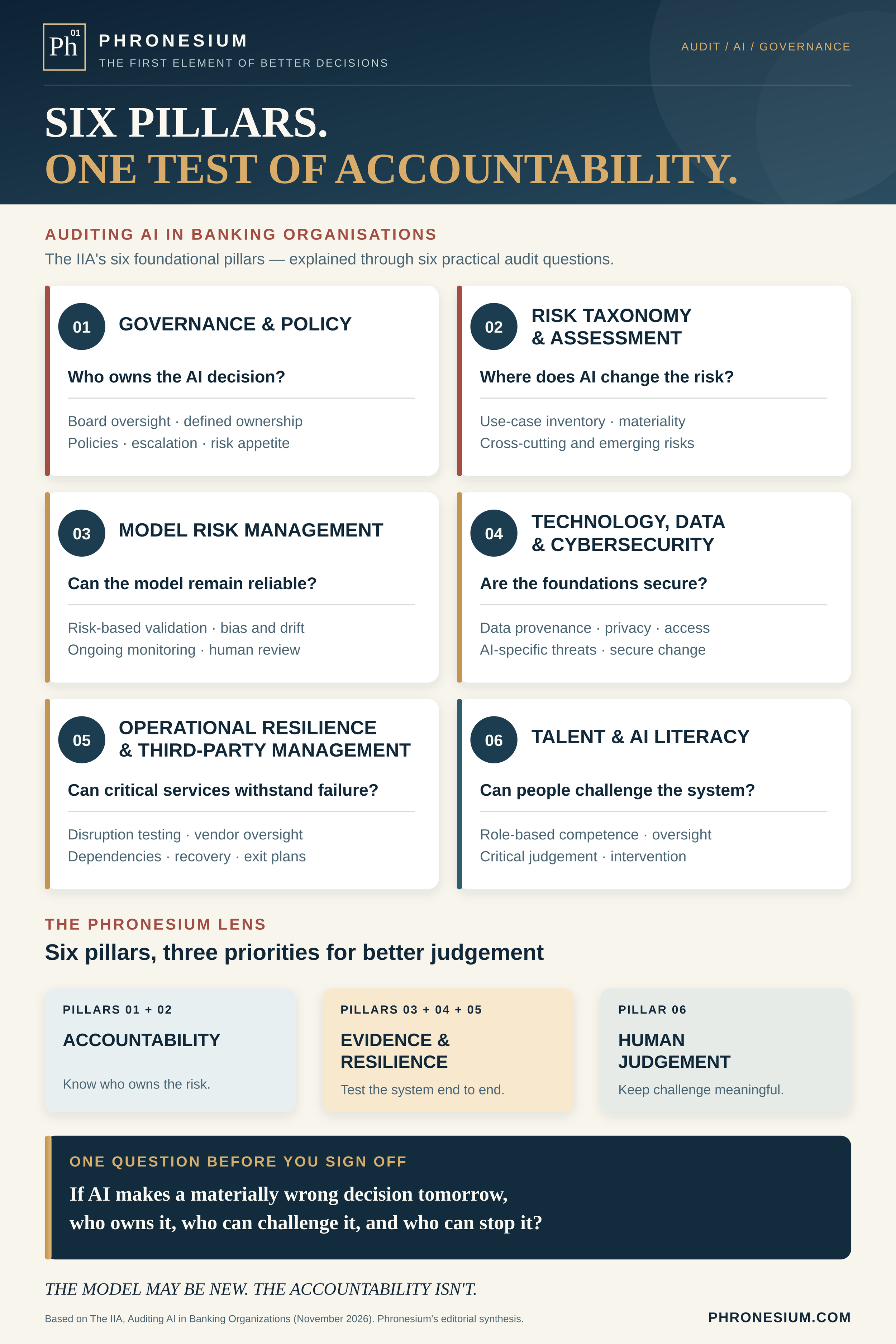
Six pillars. Three priorities. One question of accountability.
Based on the IIA's latest guidance on auditing AI in banking, this Phronesium infographic explores the six pillars of AI assurance and their connection to governance, risk, evidence and human judgement.
Because AI may change how decisions are made. It does not remove responsibility for them.
1. GOVERNANCE: TECHNOLOGY DOES NOT OWN RISK. PEOPLE DO.
The first lesson concerns accountability.
AI governance cannot simply mean approving a policy, creating a committee and maintaining a register of applications.
These things are useful.
They are not evidence that risks are being managed effectively.
The IIA emphasises that organisations should establish clear responsibilities, appropriate board oversight and risk assessments proportionate to the importance and complexity of AI use.
AI risks should also be incorporated into existing enterprise risk management arrangements.
This is particularly important in banking, where an AI system may influence lending, trading, financial crime detection, customer treatment or regulatory reporting.
The consequences can extend well beyond the technology department.
For internal auditors, the challenge is to establish whether accountability is real.
A complete inventory of AI applications is a useful starting point. But it must be connected to the business processes, risks, owners and decisions that matter.
An organisation may know which AI systems it uses without fully understanding how those systems affect its risk profile.
There is also a familiar danger: responsibility becomes fragmented across business units, technology teams, risk functions and external providers.
Everyone has a role.
Nobody owns the outcome.
The Three Lines Model remains relevant precisely because AI does not suspend the distinction between ownership, oversight and independent assurance.
The technology may be complicated. Accountability should not be.
2. ASSURANCE: AUDIT THE WHOLE SYSTEM, NOT JUST THE ALGORITHM.
The second lesson is about evidence.
Traditional model risk management remains important, but AI introduces characteristics that require particular attention.
Models can drift as conditions change.
Outputs can be inaccurate or difficult to explain.
Data can be incomplete or biased.
Generative AI can produce convincing statements that are simply wrong.
Agentic AI introduces another dimension: systems may be authorised to take actions, interact with other applications and pursue tasks with varying degrees of autonomy.
The IIA therefore encourages auditors to examine the complete AI lifecycle.
This includes model identification, development, validation, deployment, monitoring and change management.
It also includes the data supporting the model, cybersecurity protections and dependencies on third parties.
Consider a model used to detect potentially fraudulent transactions.
It performs well during initial testing.
Six months later, customer behaviour changes. The model's performance deteriorates.
The system continues operating.
The control that mattered was not merely the original validation.
It was the organisation's ability to detect deterioration, investigate its significance and intervene before customers or the bank suffered unnecessary harm.
The same principle applies to cybersecurity.
Controls must address threats such as prompt injection, data poisoning, information leakage and unauthorised actions by AI agents.
Third-party arrangements require equal attention.
Purchasing an AI solution does not transfer accountability to its supplier.
A bank must still understand material dependencies, monitor performance, test resilience and maintain credible exit arrangements.
This is where internal audit brings its established discipline.
Not merely checking whether a control exists, but determining whether it operates effectively.
Not merely examining a process, but understanding its risks, causes and consequences.
A control that works on paper but fails when needed is not much of a control.
3. COMPETENCE: HUMAN OVERSIGHT REQUIRES HUMAN UNDERSTANDING.
The third lesson may be the most underestimated.
The IIA includes talent and AI literacy as one of its six foundational pillars.
That is significant.
Organisations can invest considerable sums in sophisticated technology while paying insufficient attention to whether the people responsible for it understand its limitations.
AI literacy is not simply knowing how to write a good prompt.
Different responsibilities require different levels of understanding.
Board members must understand enough to challenge strategy and risk appetite.
Managers must understand the systems operating within their processes.
Risk and compliance teams must recognise relevant exposures and weaknesses.
Internal auditors must possess sufficient competence to assess governance, challenge evidence and evaluate controls.
A training programme with a 100% completion rate may look impressive.
But completion does not necessarily demonstrate competence.
And competence does not automatically produce sound judgement.
The more important test is whether people can recognise unreliable outputs, question assumptions, identify emerging risks and intervene when necessary.
This is particularly relevant when AI produces a recommendation that appears confident and well supported.
A polished answer can discourage challenge.
A sophisticated system can create an exaggerated sense of reliability.
And an organisation can gradually move from using AI to support decisions to accepting its outputs without sufficient scrutiny.
That is not effective human oversight.
It is approval by habit.
Human oversight has little value unless the human understands what needs to be challenged.
For internal audit, this also creates a responsibility to examine its own capabilities.
Auditors cannot provide credible assurance over systems they do not understand sufficiently to assess.
Expertise will sometimes need to be supplemented by specialists.
But the responsibility to exercise professional judgement remains.
WHAT THIS MEANS FOR INTERNAL AUDIT
The IIA's publication is valuable because it provides a common structure for examining AI-related risks across banking organisations.
It is important, however, to understand its nature.
This is principles-based guidance. It complements the Global Internal Audit Standards and relevant Topical Requirements. It does not impose one universal control framework for every AI application.
Professional judgement remains necessary when determining the scope, depth and priority of assurance work.
In my view, that is one of the publication's strengths.
A customer-service chatbot, an AI-supported credit model and an autonomous system able to execute operational tasks do not present identical risks.
They should not automatically receive identical audit treatment.
The objective is not to produce more AI checklists but to provide assurance that matters.
The six pillars offer the structure.
The auditor must still establish which risks are material, whether controls are effective and what the evidence supports.
At Phronesium, this distinction goes to the heart of better decision-making.
Information is important but evidence is essential.
But judgement determines what we do with both.
Artificial intelligence makes that distinction more important, not less.
Because the real measure of responsible AI is not how sophisticated the technology becomes.
It is whether organisations remain capable of understanding, challenging and controlling the decisions made with it.
ONE GOOD QUESTION
If an AI system makes a materially wrong decision tomorrow, can your organisation demonstrate who was accountable, what controls were operating and how the consequences would be contained?
PHRONESIUM — Better Questions. Better Judgement. Better Decisions.
Source: The Institute of Internal Auditors, Auditing AI in Banking Organizations, November 2026.
