

Which Is the Most Important Principle of Internal Audit?
Fifteen principles, one difficult question—and perhaps one principle still missing.
The Global Internal Audit Standards contain fifteen guiding principles.
They begin with integrity and end with communicating results and monitoring action plans. Between the two, internal auditors must remain objective, competent, independent, strategic, properly resourced and capable of producing reports that somebody may even read.
So, which principle matters most?
The diplomatic answer is:
All of them.
This is also the safest answer when nobody wishes to begin an argument before lunch.
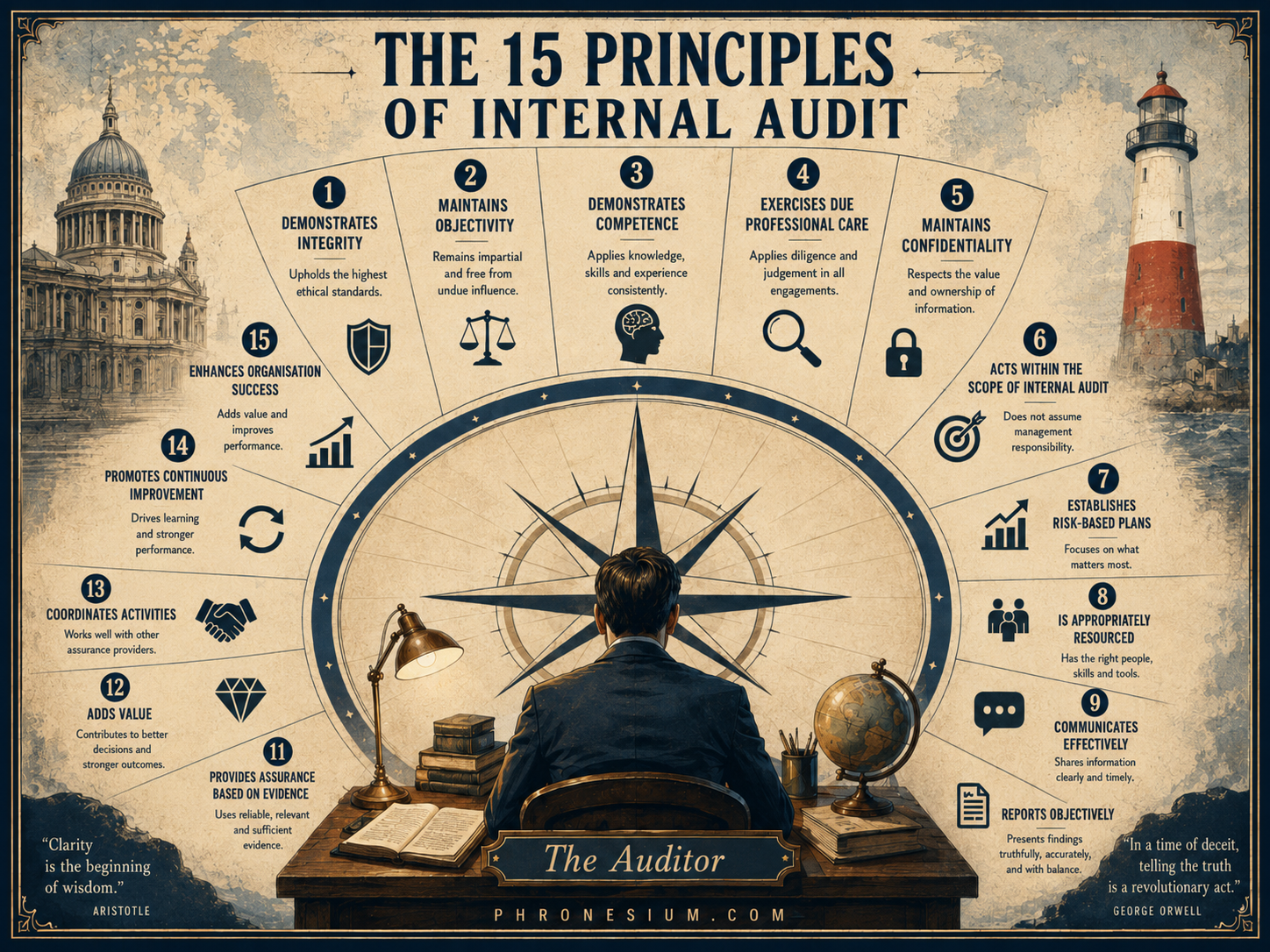
The Auditor and the 15 Principles
There sits the auditor, facing fifteen principles, a compass, a globe and what appears to be a rather serious amount of paperwork.
The principles are arranged neatly from 1 to 15—which is already an encouraging control improvement. Integrity, objectivity, competence, evidence and communication all have their place. Even continuous improvement has found a seat, although it will probably suggest rearranging everything again next year.
The compass represents direction. The lighthouse represents guidance. The globe represents the complexity of modern organisations. The desk lamp represents the auditor still working after everyone else has gone home.
At the centre is The Auditor: independent, observant and quietly wondering why the supporting evidence was not attached to the original email.
Fifteen principles. One auditor. And, ideally, no missing attachments.
Integrity must come first
Integrity is the obvious candidate.
Without integrity, objectivity becomes theatre. Independence becomes a line on an organisational chart. Communication becomes a polished way of avoiding the truth.
The Standards describe integrity as the foundation of the other principles of ethics and professionalism. That seems reasonable. An auditor without integrity may possess excellent technical skills, but so does a convincing fraudster.
Yet integrity alone is not enough.
An auditor can be honest and still misunderstand the business. Independent and still irrelevant. Competent and still produce a report so complicated that its principal achievement is remaining unread.
Perhaps the better question is not:
Which principle is most important?
Perhaps it is:….
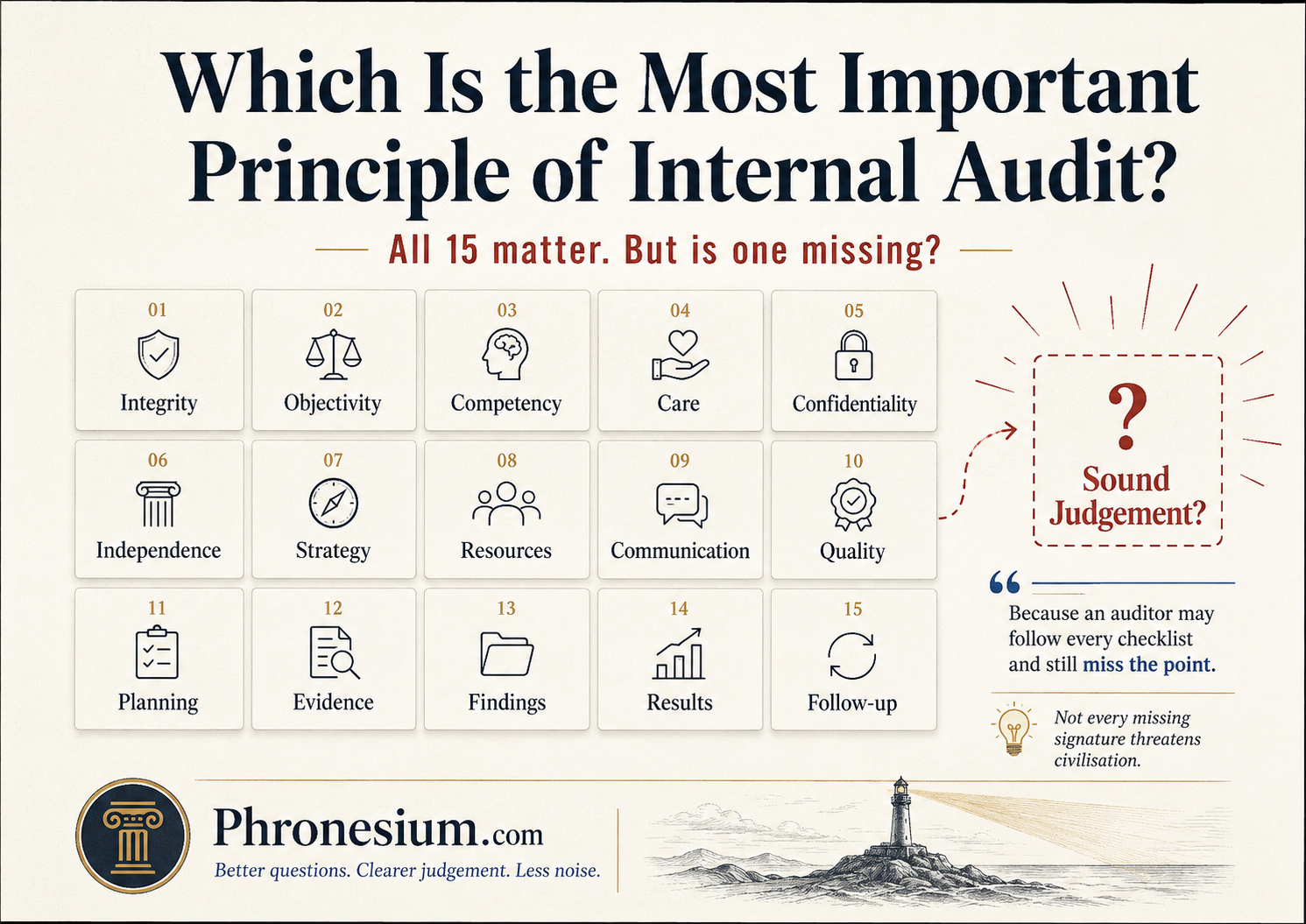
The Principle That May Be Missing
There are fifteen principles of internal audit, and all of them are important. That is the official answer, and it is also the safest one. But safety is not always clarity.
The harder question is whether something is missing. Not another rule, not another template, and certainly not another meeting, but a quality that gives the others meaning. This image suggests that the missing principle may be sound judgement. Because an auditor may follow every standard, tick every box and still fail to see what matters.
That is also the mission of Phronesium: to help people move beyond process and compliance towards clearer thinking, better judgement and better decisions.
Better questions. Clearer judgement. Less noise.
Which principle might be missing?
At Phronesium, we believe that good governance begins with good judgement.
That suggests a possible sixteenth principle:
Principle 16: Exercise Sound Judgement
Standards tell us what must be considered.
Methodologies tell us which steps to follow.
Templates tell us where to type.
Judgement tells us what matters.
It helps an auditor distinguish a genuine risk from an administrative imperfection. It tells us when more evidence is necessary, when enough is enough and when a technically correct finding is practically useless.
Judgement also requires proportion.
Not every control weakness is a crisis. Not every missing signature threatens civilisation. And not every audit report needs seventeen pages to explain something that could have been said before the coffee became cold.
Or should the missing principle be curiosity?
Another candidate might be:
Remain Curious
Curiosity encourages the auditor to ask one more question after receiving the perfectly prepared answer.
It is the quiet suspicion that the process described in the procedure may not be the process followed on Tuesday afternoon.
But curiosity without judgement can become endless testing. Judgement without curiosity can become comfortable certainty.
Internal audit needs both.
So, which principle matters most?
Integrity gives internal audit credibility.
Objectivity gives it fairness.
Competence gives it authority.
Communication gives it influence.
But judgement brings them together.
Because an auditor may follow every procedure, complete every template and satisfy every checklist—and still miss the point.
Perhaps the most important principle is therefore not one principle at all.
It is the wisdom to know which principle matters most at the moment it is needed.
That is the idea behind Phronesium: practical wisdom for clearer thinking, better governance and better decisions.
Discover more at phronesium.com.
Please share your thoughts or write to me through phronesium.com.
Internal audit already has enough checklists. A thoughtful disagreement may be considerably more useful.
Better questions. Clearer judgement. Less noise.
