

Bud Spencer Saw It Coming
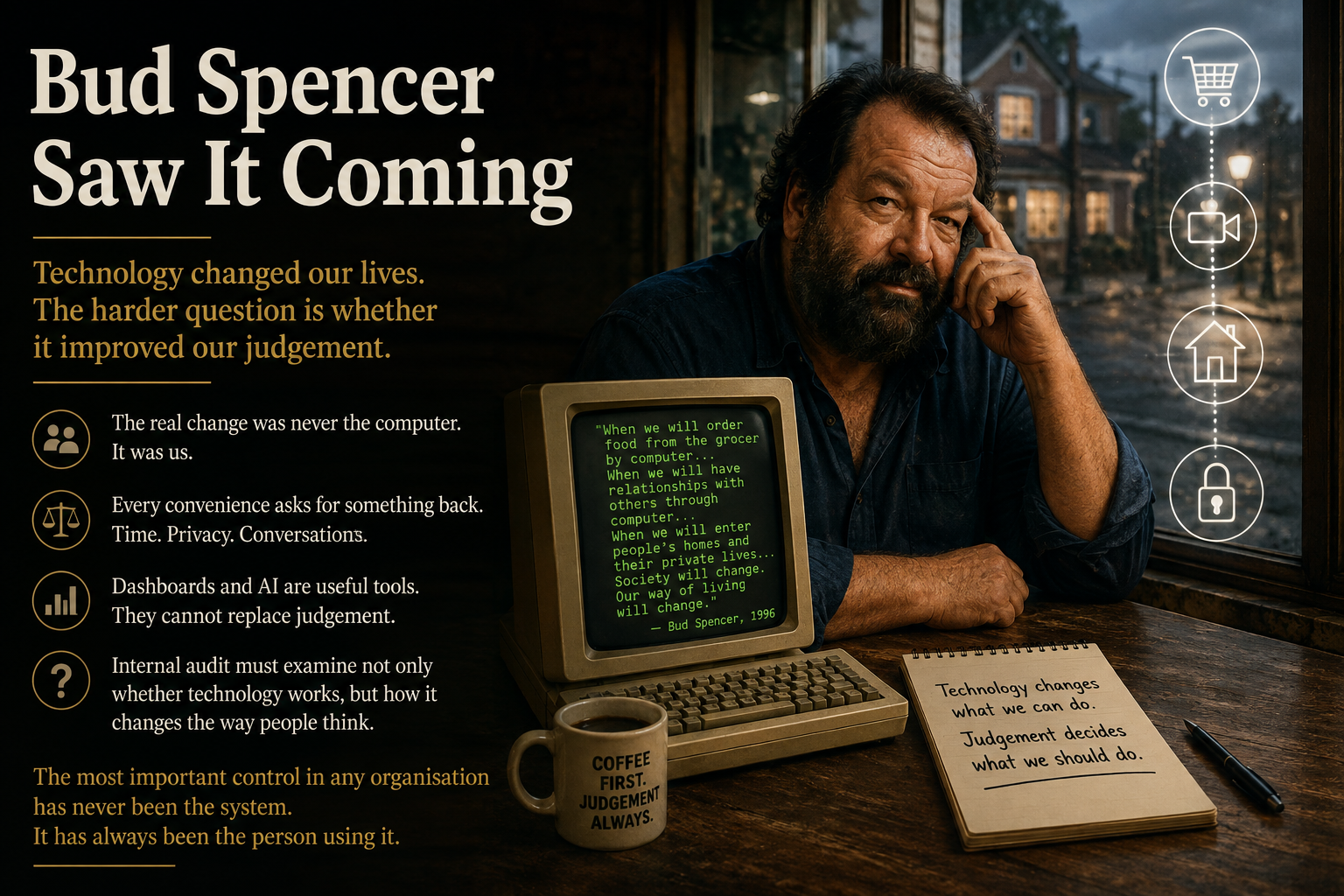
Technology changes what we can do. Judgement decides what we should do.
In 1996, most of us still thought of computers as expensive typewriters.
The internet was slow.
Mobile phones were mainly for making phone calls.
Bud Spencer looked at all of that and quietly made a prediction.
One day we would order food through a computer.
We would speak to one another through a screen.
Technology would enter our homes.
Then it would enter our private lives.
Finally, he reached a simple conclusion.
"Society will change. Our way of living will change."
Looking around today, it is difficult to argue with him.
We order dinner without speaking to the restaurant.
We attend meetings without leaving home.
We know what friends are doing before they tell us. Sometimes we know what complete strangers had for breakfast.
The computer did not stay on the desk.
It entered the house.
Then it entered our relationships.
Eventually, it began to shape the way we make decisions.
It was never really about technology
It is easy to read Bud Spencer's words as a prediction of online shopping, social media and video calls.
I think he was pointing to something much bigger.
The computer itself was never the real story.
People were.
Technology changed how we communicate. How we work. How we shop. How we spend our time. Perhaps most importantly, it changed how easily we could step into other people's private lives.
He said that in 1996.
Long before smartphones.
Long before social media.
Long before artificial intelligence became part of everyday conversation.
That is what makes the interview remarkable.
He was not predicting better machines.
He was predicting different human behaviour.
Every convenience asks for something back
Technology has made many things better.
There is little point pretending otherwise.
I booked today's journey on my phone.
I can speak to someone on another continent in seconds.
Internal auditors can analyse millions of transactions instead of selecting a sample.
Those are real improvements.
But progress is rarely free.
Every convenience quietly asks us to give something back.
Sometimes it is time.
Sometimes it is privacy.
Sometimes it is the habit of speaking to another human being instead of another screen.
We rarely notice the trade until it has already happened.
Organisations are changing as well
Exactly the same thing has happened inside organisations.
Dashboards tell executives what is happening.
Artificial intelligence drafts reports, summarises documents and highlights unusual patterns.
Audit teams analyse entire populations instead of testing a handful of transactions.
Useful?
Absolutely.
Enough?
Not even close.
A dashboard can tell you that a control failed.
It cannot tell you whether the control failed because people stopped thinking.
AI may recommend a decision.
It cannot own the consequences.
Sooner or later, every important decision reaches the same point.
Someone has to accept responsibility.
Technology cannot do that.
Faster is not always better
Most digital transformation programmes promise efficiency.
Usually, they deliver.
Removing pointless paperwork is progress.
Automating repetitive work is progress too.
But not every pause is waste.
Sometimes the pause is where judgement lives.
Someone asks one more question.
Someone challenges an assumption.
Someone quietly says, "Are we sure?"
Those moments never appear on a dashboard.
Yet they prevent more mistakes than many dashboards will ever detect.
Technology makes decisions faster.
Judgement is what makes them better.
What should internal audit ask?
Internal audit should certainly ask whether technology works.
It should also ask what technology is doing to the organisation.
Are decisions improving, or simply happening more quickly?
Are people communicating better, or avoiding difficult conversations?
Are leaders seeing more clearly, or becoming overconfident because the numbers look precise?
Are employees still thinking?
Or are they becoming very efficient at following whatever the system recommends?
Those are governance questions.
Internal audit has always examined controls.
Increasingly, it must also examine how technology changes judgement.
That is a much harder audit.
The screens show information. The cameras watch. The machine calculates. Only people can exercise judgement. That is the control worth protecting.
The real lesson
Bud Spencer never suggested that technology was the enemy.
He simply understood that it would change us.
Thirty years later, that no longer sounds like a prediction.
It sounds like an ordinary day.
The difficult question is no longer whether computers can think.
It is whether people still do.
Internal audit cannot answer that question on its own.
But it should never stop asking it.
Because organisations rarely fail because the software was wrong.
They fail because people stopped exercising judgement.
Technology will continue to evolve.
It always will.
The real challenge is making sure our judgement keeps pace.
Because the most important control in any organisation has never been the system.
It has always been the person sitting in front of it.
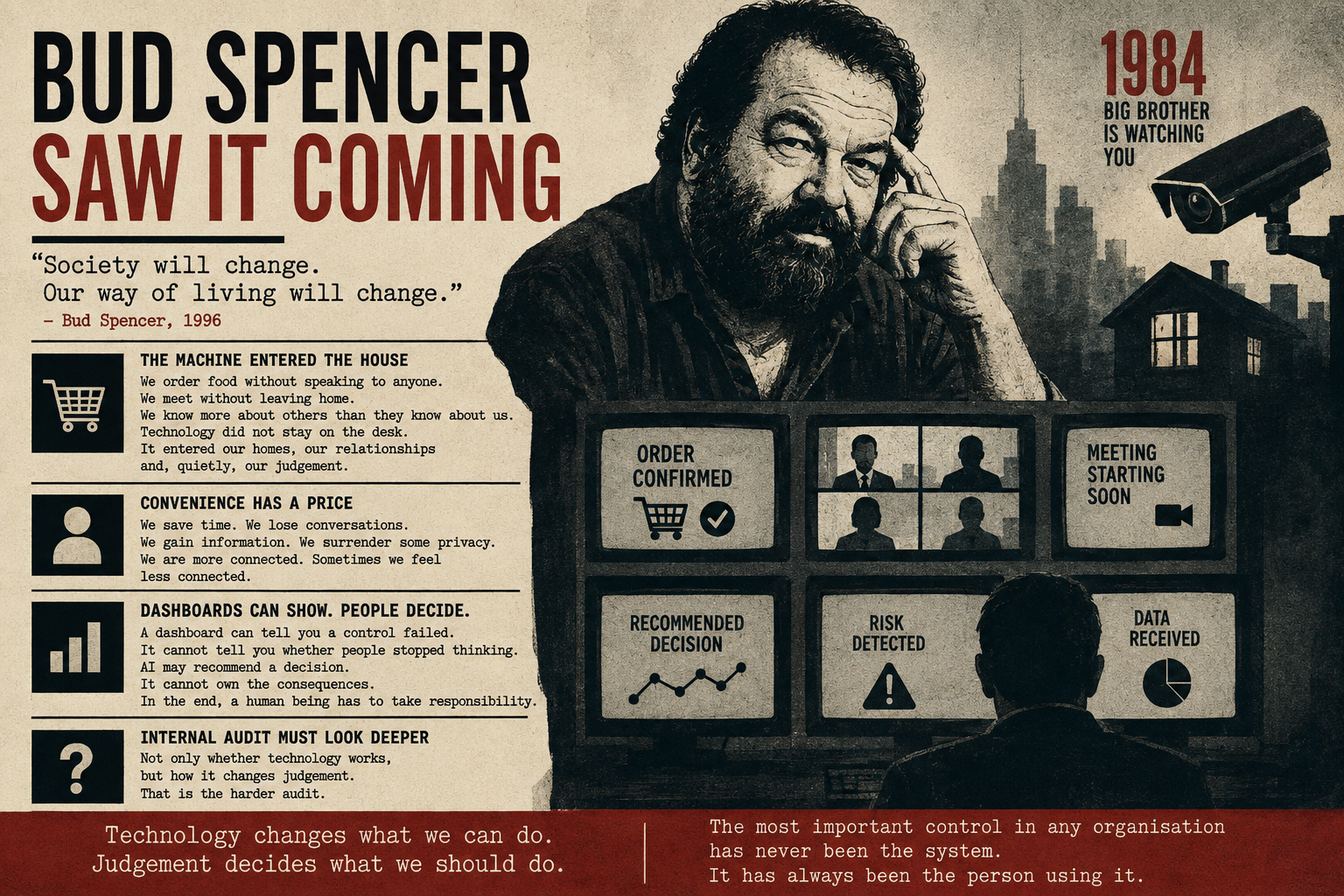
Bud Spencer understood that the real revolution would not be the computer. It would be what the computer did to us. Technology can make decisions faster. It cannot make them wiser. That remains our job.
