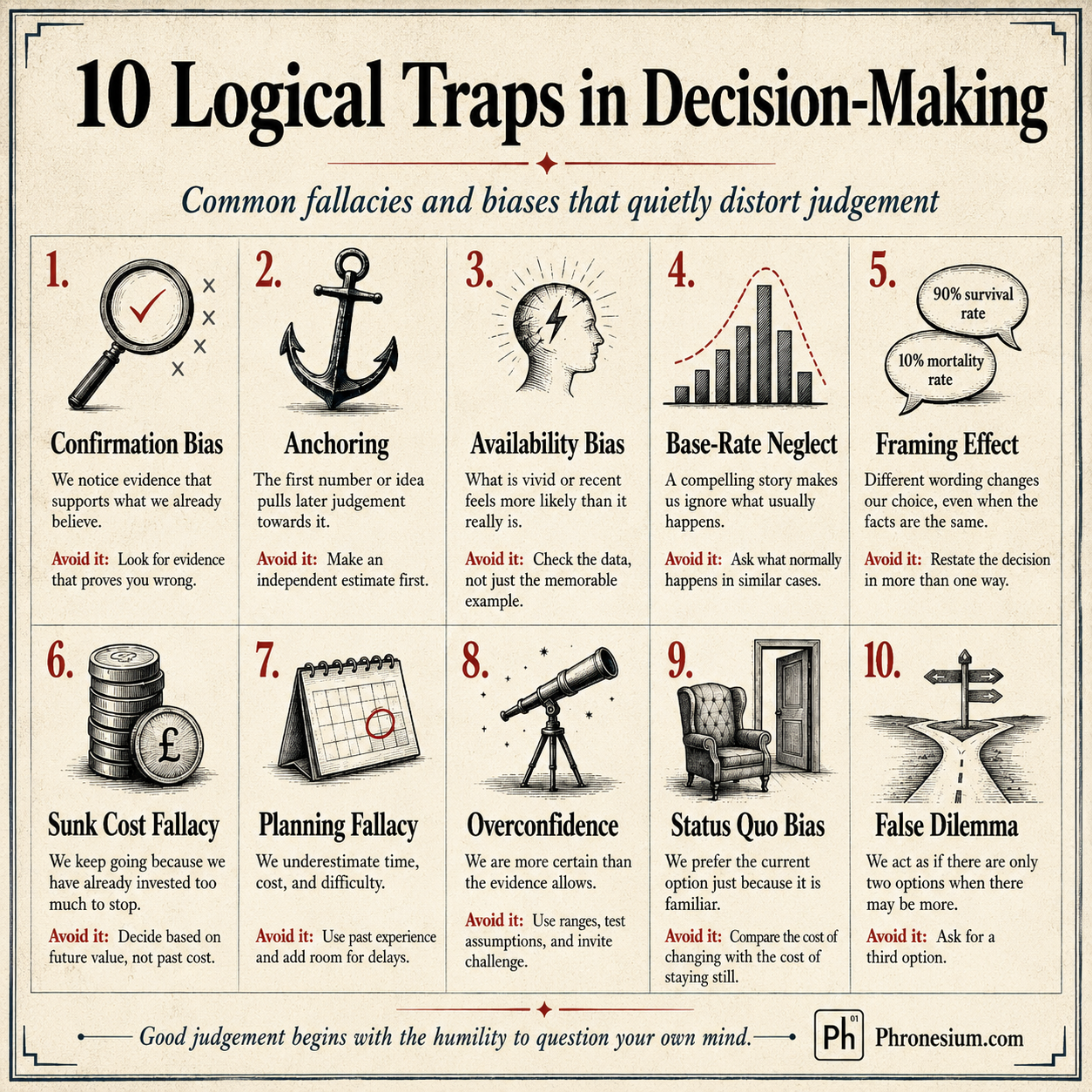
10 Traps in Decision-Making
Logical fallacies and cognitive biases that quietly distort judgement
Bad decisions rarely begin with stupidity.
More often, they begin with a reasonable person seeing only part of the picture—and mistaking it for the whole.
Our minds use shortcuts. They have to. We cannot examine every fact, calculate every probability and explore every possible future before choosing what to have for lunch, let alone approving an investment or issuing an audit opinion.
Most of the time, these shortcuts help us.
Sometimes, however, they become traps.
Strictly speaking, not every trap below is a logical fallacy. Some are cognitive biases. A fallacy is usually a weakness in an argument. A bias is a predictable tendency in how we judge information. In real decisions, the two often work together: the bias shapes what we notice, and the fallacy helps us defend the conclusion.
Here are ten of the most common.
1. Confirmation bias
The trap
We search for evidence that supports what we already believe.
Once we have formed an opinion, friendly facts become highly visible. Unfriendly facts are questioned, minimised or quietly ignored.
Peter Wason’s early experiments showed how readily people seek evidence that confirms a hypothesis rather than evidence that might disprove it.
An example
An auditor believes that a department has a weak control culture.
Every delayed response becomes proof.
Prompt responses, effective controls and evidence of improvement are treated as exceptions.
The audit may still reach the right conclusion. But it may arrive there unfairly.
How to avoid it
Ask:
“What evidence would prove me wrong?”
Actively search for disconfirming evidence. Give someone the formal role of challenging the preferred conclusion. Record evidence both for and against the decision.
A conclusion that survives a serious attempt to disprove it is stronger than one supported only by friendly facts.
2. Anchoring
The trap
The first number, opinion or estimate we encounter becomes an anchor.
Later judgements are pulled towards it—even when the original figure was arbitrary or poorly supported. Anchoring was one of the principal judgement patterns identified by Amos Tversky and Daniel Kahneman.
An example
Management estimates that a remediation programme will cost £2 million.
The audit team challenges the assumptions and concludes that it may cost £2.6 million.
But perhaps the correct estimate was £5 million.
The original figure did not merely enter the conversation. It defined its boundaries.
How to avoid it
Make an independent estimate before seeing someone else’s figure.
Use several reference points rather than one. Ask where the first number came from and whether it deserves any influence at all.
The first number should start the discussion—not control it.
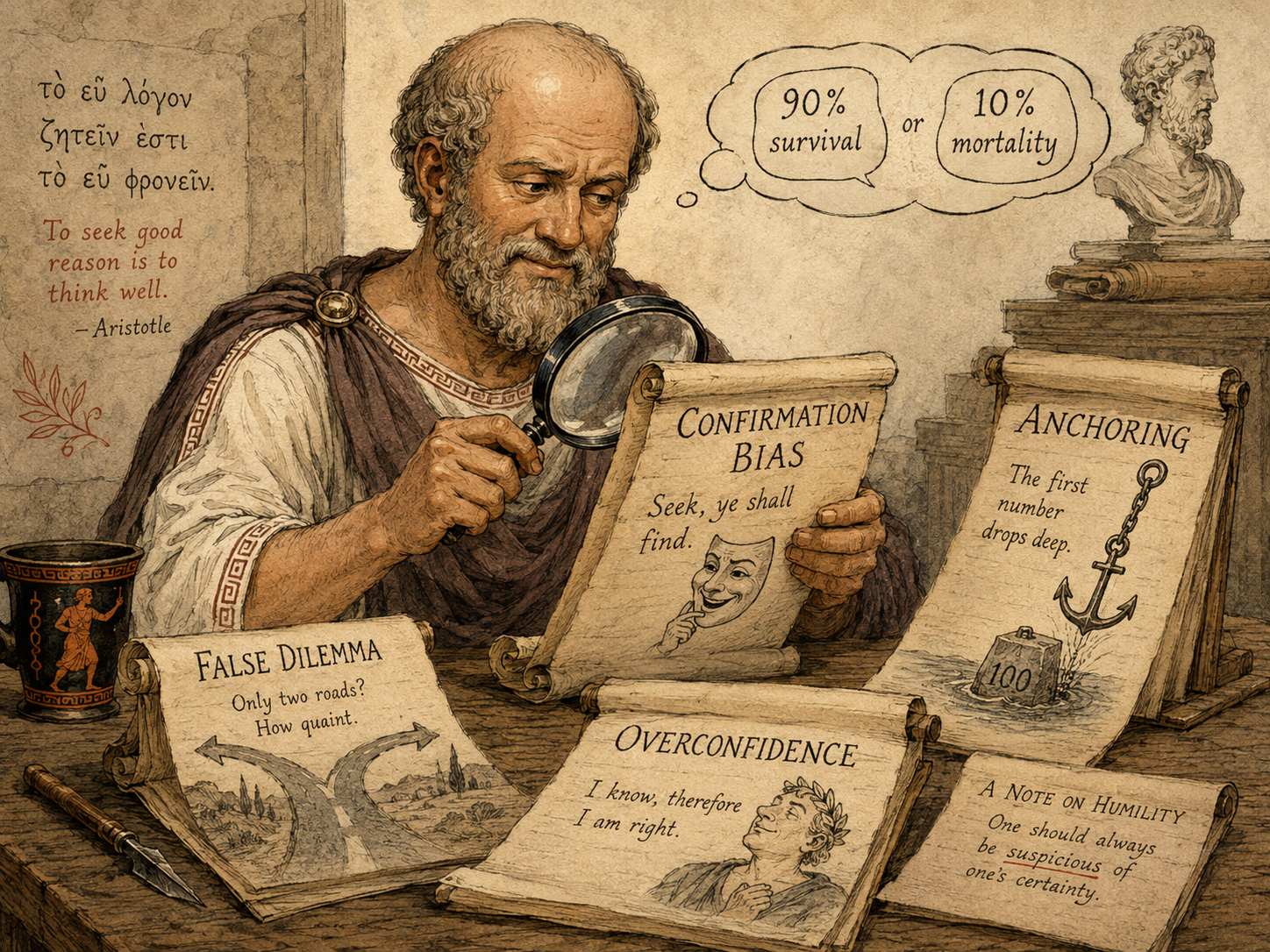
Aristotle and the Traps of Reason
Aristotle was the first philosopher to classify logical fallacies systematically. In On Sophistical Refutations, he showed how an argument can appear true without being sound.
We includes cognitive biases such as confirmation bias, anchoring and overconfidence which are psychological traps rather than classical fallacies, but both can distort judgement.
An argument may look true without being true. The task of judgement is to notice the difference.
3. The availability bias
The trap
We judge likelihood by how easily an example comes to mind.
Recent, dramatic and emotional events feel more common than they really are. Quiet, ordinary events receive less attention, even when they happen far more frequently.
An example
After a large cyberattack appears in the news, an organisation redirects much of its attention towards that particular threat.
The threat may be serious.
But the organisation may now neglect less dramatic risks that are statistically more likely or already causing harm.
What is memorable is not always what is probable.
How to avoid it
Look at frequency data over a meaningful period.
Ask whether the risk is genuinely increasing or simply receiving more attention. Separate what is vivid from what is common.
A recent example is still only one example.
4. Base-rate neglect
The trap
We focus on the details of the current case and ignore what usually happens in similar cases.
A convincing story defeats the statistics.
Kahneman and Tversky found that people often give too much weight to how representative a description appears and too little weight to the prior probability—or base rate—of the outcome.
An example
A project team presents a persuasive account of why its transformation programme is unique.
It has better people, stronger technology and firmer executive support.
Perhaps it does.
But many failed projects once believed the same thing.
How to avoid it
Ask:
“What normally happens to projects like this?”
Identify a relevant comparison group. Examine actual completion rates, costs, failures and benefits.
The current case matters. History matters too.
5. The framing effect
The trap
Our choice changes according to how the same information is presented.
A treatment with a 90% survival rate sounds more attractive than one with a 10% mortality rate, even though the numbers describe the same outcome.
Tversky and Kahneman demonstrated that changes in framing can produce predictable changes in choices.
An example
A proposal promises to “protect 80% of current revenue”.
Another warns that the organisation “may lose 20% of current revenue”.
The facts are identical.
The emotional response is not.
How to avoid it
Rewrite the decision in more than one way.
Express both gains and losses. Use absolute numbers as well as percentages. Ask whether the recommendation would change if the wording were reversed.
A sound decision should survive a change of sentence.
6. The sunk cost fallacy
The trap
We continue because we have already invested money, time, reputation or effort.
The past expenditure cannot be recovered. Yet it influences what we decide to spend next.
Research by Hal Arkes and Catherine Blumer found that people become more likely to continue an endeavour once an investment has been made.
An example
A technology programme is late, over budget and no longer aligned with the organisation’s strategy.
But cancelling it would mean admitting that £10 million had been wasted.
So another £5 million is approved.
The organisation does not rescue the first investment. It merely risks losing the second.
How to avoid it
Ask:
“Knowing what we know today, would we start this project again?”
Consider only future costs, future benefits and realistic alternatives.
Past expenditure may explain how we arrived here. It should not decide where we go next.
7. The planning fallacy
The trap
We underestimate how long a task will take, how much it will cost and how many things may go wrong.
We imagine the plan working. We do not imagine the interruptions, dependencies, delays and ordinary human complications.
Research on the planning fallacy found that people tend to focus on their intended scenario rather than relevant past experience, producing overly optimistic completion estimates.
An example
A remediation programme is expected to take six months.
The estimate assumes prompt recruitment, clean data, stable requirements, available technology teams and rapid approval.
In other words, it assumes that nothing behaves normally.
How to avoid it
Use the outside view.
Look at how long comparable work actually took. Break the plan into smaller tasks. Conduct a premortem: imagine that the project has failed and ask what caused the failure.
Then add enough time for reality to enter the room.
8. Overconfidence
The trap
We are more certain than our knowledge justifies.
Overconfidence can appear as overestimating our ability, believing we are better than others or expressing excessive precision in our forecasts.
An example
A senior executive says:
“There is a 95% probability that the programme will be delivered by December.”
The number sounds scientific.
But it may be confidence dressed as mathematics.
How to avoid it
Use ranges rather than unsupported single-point estimates.
Keep records of earlier forecasts and compare them with actual outcomes. Invite independent review. Distinguish clearly between what is known, what is estimated and what is merely hoped.
Confidence is useful.
Uncalibrated confidence is a risk.
9. Status quo bias
The trap
We prefer the current position because it is familiar.
The existing system is treated as safe, even when its weaknesses are known. Change must prove itself. Inaction is rarely asked to do the same.
Experiments by William Samuelson and Richard Zeckhauser showed that decision-makers disproportionately remain with the status quo.
An example
An organisation continues using a slow, manual control because it has “always worked”.
A new automated control is rejected because it introduces implementation risk.
The risks of change are visible.
The accumulated costs and risks of doing nothing are not.
How to avoid it
Make both options defend themselves.
Ask for the risks, costs and consequences of changing—and of not changing. Imagine that the proposed new arrangement already existed. Would you pay to replace it with the current one?
Inaction is also a decision.
10. The false dilemma
The trap
We present two options as though they were the only options.
Either we approve the proposal immediately or we lose the opportunity.
Either we trust management or we accuse management of dishonesty.
Either the control works perfectly or it is useless.
False dilemmas narrow a complex decision by excluding possible alternatives or treating options as mutually exclusive when they are not.
An example
A project sponsor says:
“We either launch this month or abandon the entire programme.”
But there may be other choices: a pilot, a phased launch, a smaller scope, temporary controls or a revised timetable.
The missing option may be the best one.
How to avoid it
Ask:
“What is the third option?”
Then ask for a fourth.
Look for combinations, pilots, stages and reversible decisions. Be suspicious when a complicated problem arrives with only two possible answers.
Reality rarely works in binary.
Awareness Is Not Enough
Learning the names of these traps does not make us immune to them.
In fact, knowledge can create another form of overconfidence: we begin to see bias clearly in everyone except ourselves.
The better defence is not intelligence. It is process.
Before an important decision, ask:
What evidence contradicts my preferred conclusion?
What was the first number or opinion I heard?
Am I relying on a vivid example rather than reliable data?
What normally happens in comparable situations?
Would different wording change my choice?
Would I make the same decision if no money had yet been spent?
What happened when we attempted similar work before?
How confident should I genuinely be?
What is the cost of keeping things as they are?
Which alternatives have not yet been considered?
At Phronesium, we are interested in better decisions.
That means studying logic. But it also means studying psychology.
Logic tells us whether an argument stands.
Psychology helps us understand why we may want it to stand—even when it should fall.
Good judgement does not require a perfect mind.
It requires enough humility to question an imperfect one.