

Collaboration Is Good. Until it isn’t.
Collaboration is usually treated as an unquestionable good. But what happens when cooperation becomes conformity, or when competition creates the challenge an organisation actually needs?
Inspired by a reflection from Sandro Boeri, this article explores a simple idea: the goal is not more collaboration or more competition, but the judgement to know when each is useful.
Why Sandro Boeri is right to question the idea that more collaboration is always better
Collaboration is one of those words that has acquired an almost automatically positive meaning in organisations.
We want more collaboration, more teamwork, more alignment, more sharing.
Rarely do we hear somebody say: perhaps we are collaborating too much.
Sandro Boeri recently made a point that made me think about this.
There is no single “best” organisational culture. Some environments depend heavily on collaboration. Others deliberately create a degree of competition because it can encourage performance, accountability and results.
Investment banking, professional sport, law firms, academia and investment management are all examples where competition can be part of the way the system works rather than evidence that the culture has somehow failed.
Sometimes competition is there by design.
This raises a more interesting question than simply asking whether an organisation is collaborative enough:
Does our culture create the behaviours and outcomes we actually need?
That question is more difficult.
Which is probably why it is more useful.
When collaboration becomes conformity
There is nothing particularly controversial about saying that collaboration is useful.
People share information. They solve problems together. They combine different skills. They coordinate work that would be difficult, or sometimes impossible, to manage alone.
The problem starts when collaboration becomes confused with agreement.
If agreement becomes more important than challenge, a collaborative culture can gradually become a conformist one.
People stop asking:
Are we right?
and begin asking:
Are we all aligned?
I do not think these are the same question.
A room full of people agreeing with one another may be evidence of a very good team.
It may also be evidence that nobody particularly wants to be the person who says, “I am not sure this makes sense.”
Anyone who has spent enough time in meetings will probably recognise both possibilities.
For Internal Audit, risk and governance, the distinction matters. We need cooperation. Auditors cannot do their work by standing heroically alone in a corner.
But professional judgement also requires independence of thought.
If collaboration removes challenge, we may have gained harmony at the expense of judgement.
And competition?
Competition tends to receive the opposite treatment.
We are suspicious of it, and sometimes for good reason.
Too much competition can damage trust. People may stop sharing information. They may start protecting their own position rather than thinking about what is best for the organisation.
But that is not the whole story.
Competition can also encourage people to improve, challenge assumptions and take greater responsibility for results.
So perhaps competition itself is not the problem.
And collaboration, by itself, is not the answer.
The more interesting issue is one of proportion.
How much cooperation do we need?
How much challenge?
How much individual accountability?
And, perhaps most difficult of all, when does one begin to undermine the others?
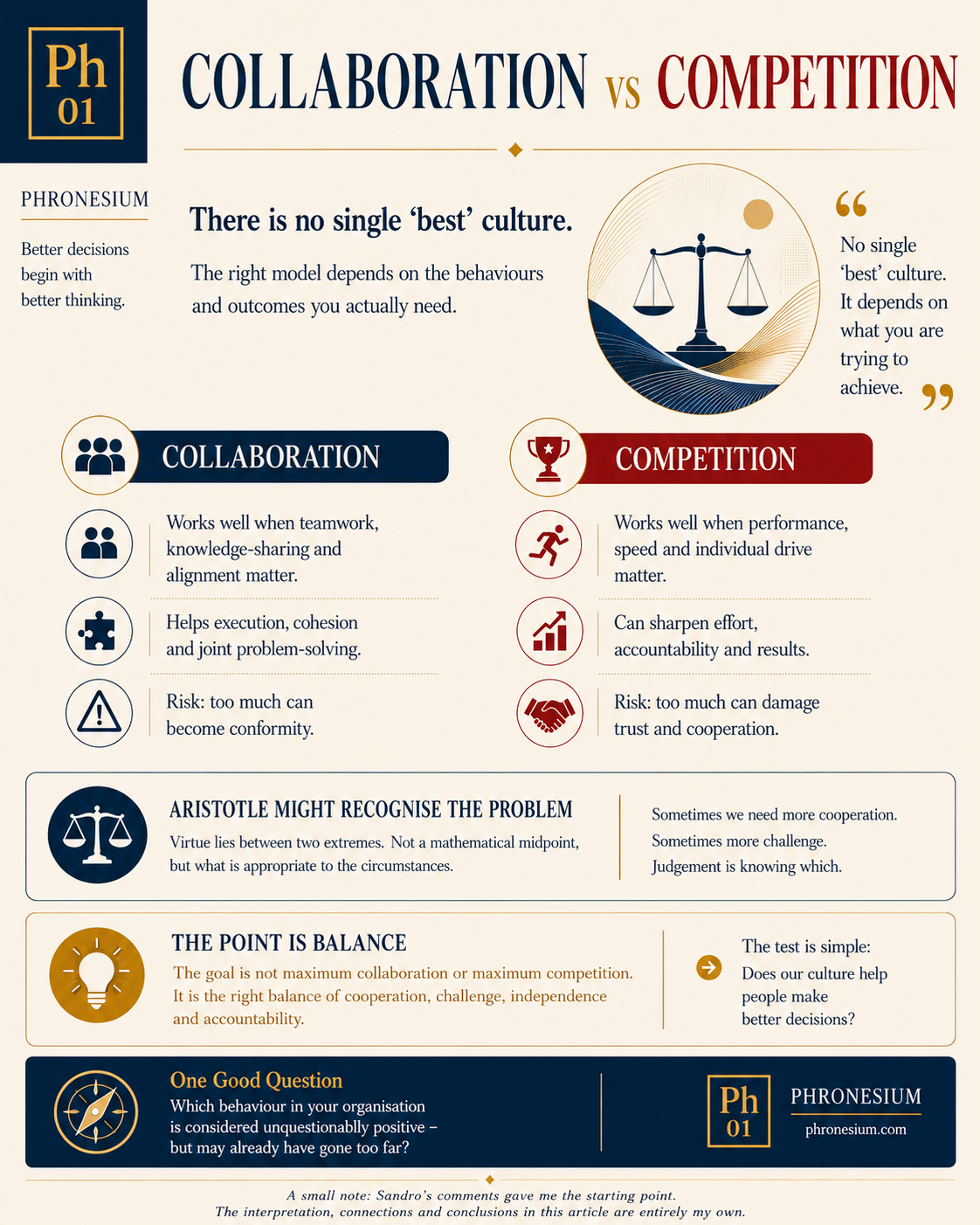
The Balance Between Cooperation and Challenge
This visual captures the central idea of the article: collaboration is valuable, but not sacred. Too little can create silos; too much can quietly turn agreement into conformity. The better culture is not the one with the most collaboration or the most competition, but the one that gets the balance right between cooperation, challenge, independence and accountability.
In other words, collaboration is good. Until everyone agrees a little too easily.
Aristotle might recognise the problem
This is where Sandro’s observation took me somewhere slightly unexpected.
Aristotle.
More than two thousand years ago, Aristotle argued that virtue often lies between two extremes: excess on one side and deficiency on the other.
His idea of the “mean” was not simply the mathematical middle.
It was what was appropriate to the circumstances.
That distinction matters.
The answer is clearly not to design an organisation around 50% collaboration and 50% competition. Culture is not a cake recipe.
Sometimes an organisation needs more cooperation.
Sometimes it needs more challenge.
Sometimes it needs people to share more.
And sometimes it may need people to worry a little less about consensus and disagree with one another properly.
The difficult part is knowing which.
For me, that is where the idea becomes interesting, because this is really a question of judgement.
The “right balance” is not something we can calculate once and write into a policy.
It depends on the people, the circumstances and what the organisation is trying to achieve.
So where is the balance?
I do not think the conclusion is that collaboration is better than competition.
Nor do I think it is that competition produces better performance.
Both statements are too easy.
The more useful idea is that we probably need some combination of cooperation, challenge, independence and accountability.
The balance will differ between organisations.
It may even differ between teams within the same organisation.
And it may change over time.
The test, therefore, is probably not whether our culture looks like somebody else’s idea of a “good culture”.
It is whether it helps people think clearly, challenge when necessary, work together when useful and ultimately make better decisions.
Sandro’s observation made me reconsider something that sounds obviously positive.
I usually find those are the ideas worth examining.
One Good Question
Which behaviour in your organisation is considered unquestionably positive — but may already have gone too far?
Inspired by a reflection from Sandro Boeri
This article was prompted by a recent video from Sandro Boeri in which he questions the assumption that collaboration is always the ideal organisational model.
His point made me think. Perhaps the better question is not whether an organisation is collaborative enough, but whether its culture creates the behaviours and outcomes it actually needs.
What I wrote are my own reflection on that idea, including the connection with Aristotle, judgement and the balance between collaboration and competition. The interpretation and conclusions are entirely my own.
Source: Sandro Boeri, LinkedIn video on collaboration, competition and organisational culture. Watch the original video on LinkedIn.
About Sandro Boeri
Sandro Boeri is a Culture & Leadership Advisor to Boards and Executives, keynote speaker and experienced practitioner in risk, audit and organisational culture.
