

Six Thinking Hats: A Simpler Way to Think Together
The Wisdom Honeycomb - six modes of thought for better decisions and better audits
Have you ever sat in a meeting where everyone was intelligent, everyone was engaged and nothing useful happened?
One person wanted more facts. Another saw only the risks. Someone else had a new idea. A fourth person simply felt that something was wrong.
They were not necessarily disagreeing. They were thinking in different ways at the same time.
That is the problem Edward de Bono addresses in Six Thinking Hats. His answer is simple: stop asking the mind to do everything at once.
Six Ways to Think. One Better Decision.
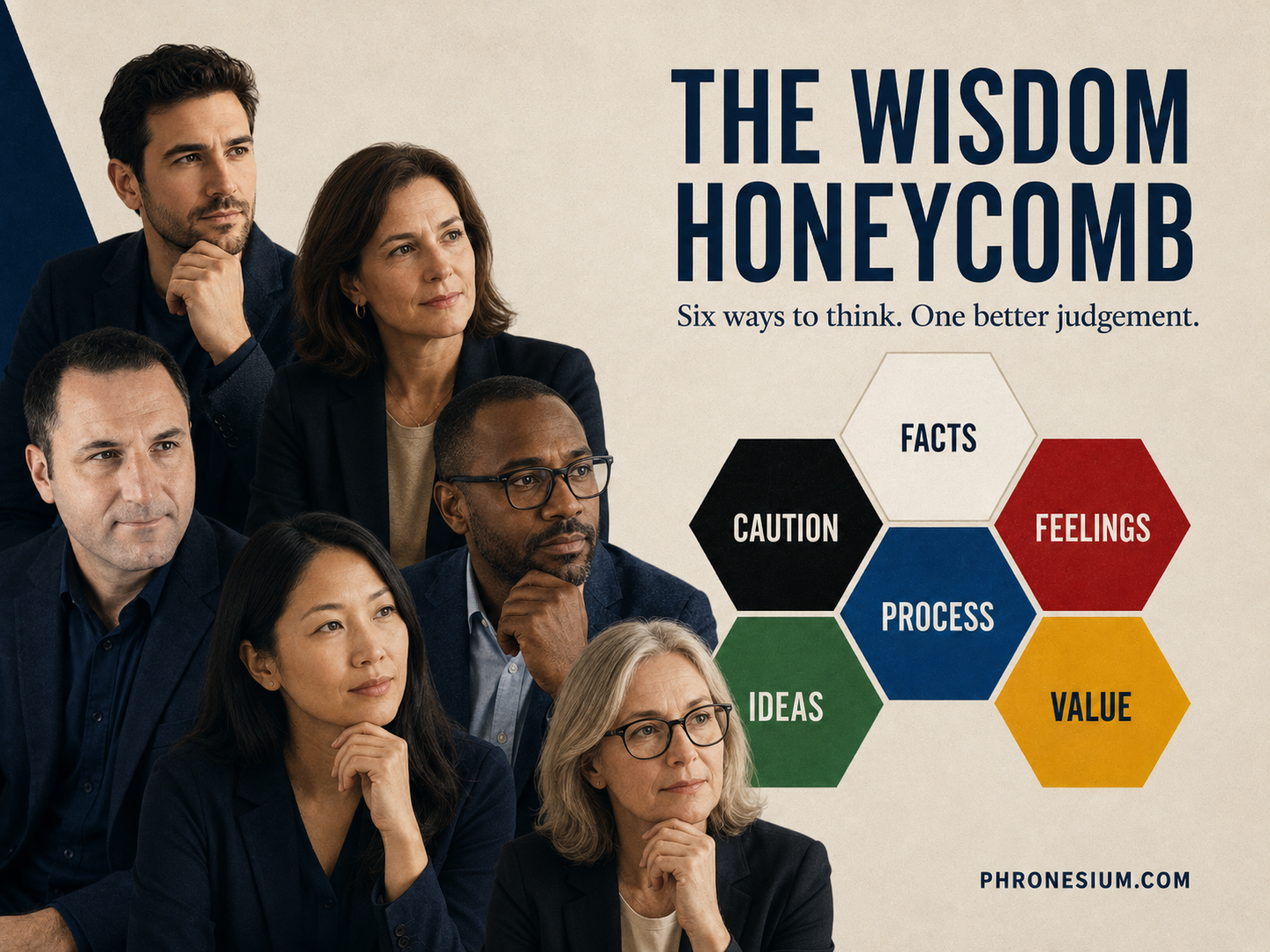
The Wisdom Honeycomb brings together facts, feelings, caution, value, ideas and process—six views, one better judgement.
Better decisions need more than one way of thinking.
The problem is not always poor thinking
Sometimes the problem is crowded thinking.
Facts, feelings, caution, hope, creativity and process all compete for attention. We mix them together and call the result discussion. Then we defend our favourite part as though it were the whole truth.
De Bono separates these modes by giving each one a coloured hat. The hat is not a personality label. You are not a black-hat person or a green-hat person. The point is that everyone can put on every hat.
This changes the conversation. Instead of one person attacking and another defending, the group can look in the same direction together. Everyone examines the facts. Everyone tests the risks. Everyone looks for value. Everyone generates alternatives.
The argument becomes a map.
From six hats to one honeycomb
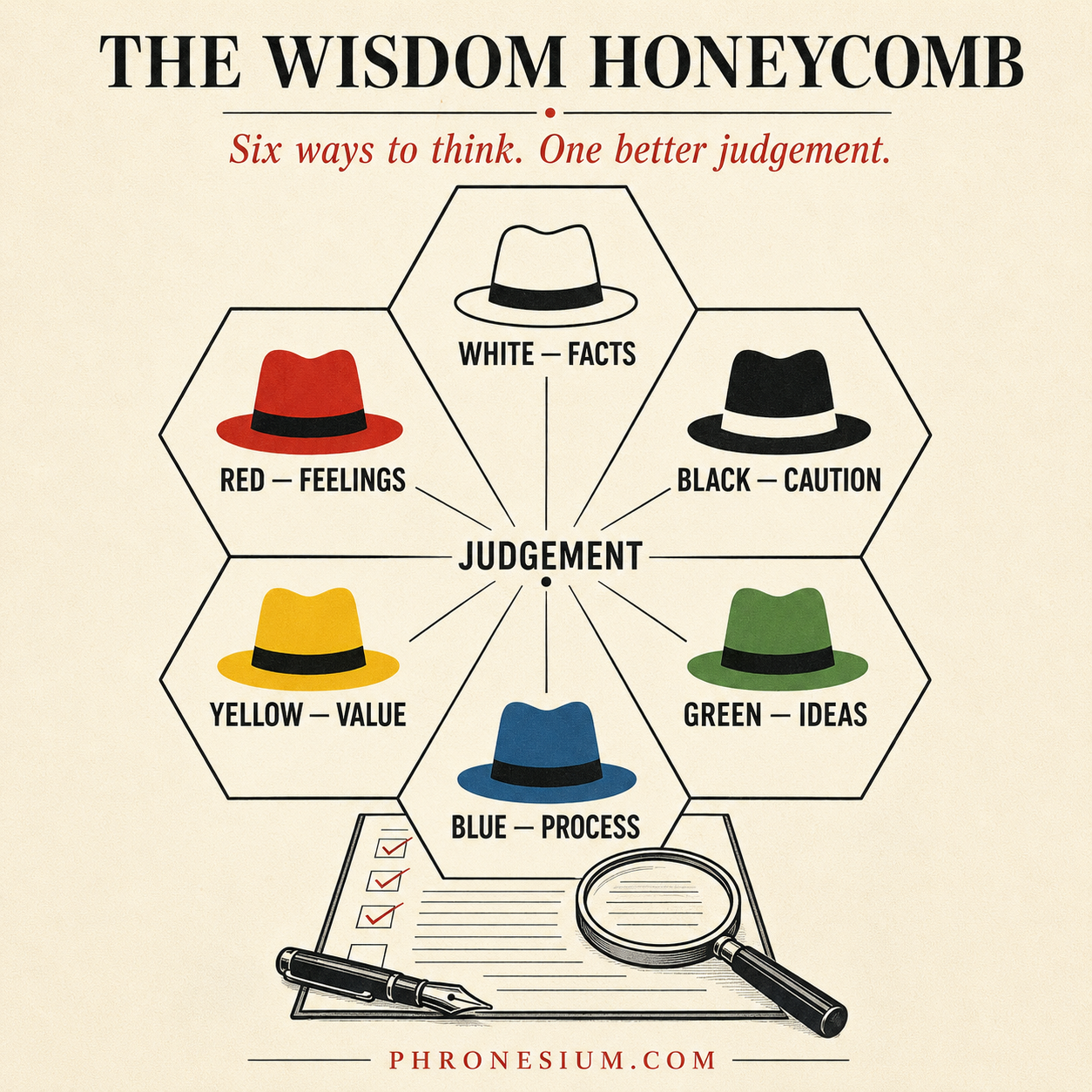
At Phronesium, we have translated the idea into the Wisdom Honeycomb: six hexagonal cells, each performing a different thinking job.
The honeycomb matters because it shows both separation and connection. Each cell has its own purpose. None is sufficient alone. Strength comes from the structure they form together.
White: What do we know?
The white cell deals with facts and information. It asks what has been verified, what is believed, what is estimated and what is still missing. For auditors, this is the discipline of evidence. A confident statement is not automatically a fact. A document is not automatically proof.
Red: What do we feel?
The red cell gives feelings and intuition a legitimate place. An experienced auditor may sense that an explanation is too neat or that a control is weaker than it appears. That feeling should not become a finding. But neither should it be buried. It can become a question worth testing.
Black: What could go wrong?
The black cell examines risk, error, inconsistency and failure. Auditors know this mode well. It protects the organisation from weak assumptions and unintended consequences. But black thinking must be logical and proportionate. Permanent negativity is not professional scepticism.
Yellow: What may work?
The yellow cell looks for value, strength and opportunity. It asks what is effective and why. This matters in audit because an honest report should not only describe failure. It should recognise sound controls, workable practices and improvements that can be spread.
Green: What else is possible?
The green cell creates alternatives. It moves beyond the first acceptable explanation or action. When the proposed remedy is “more training”, green thinking asks whether the process, system, ownership or control design should change instead.
Blue: How shall we think?
The blue cell manages the process. It defines the question, chooses the sequence, keeps the discussion focused and brings the other cells into a conclusion. In audit, blue thinking is essential at planning, closing meetings, report drafting and issue closure.
Make it stand out
The Wisdom Honeycomb: Six Ways to Think Without Losing the Plot
Meetings are curious places.
Six intelligent people enter a room, each carrying a useful thought. One brings facts. Another brings caution. A third brings an idea. Someone has a feeling they cannot quite explain. Within twenty minutes, everyone is speaking and nobody is listening.
The problem is not a shortage of intelligence. It is intelligence arriving all at once and refusing to queue.
The Wisdom Honeycomb, inspired by Edward de Bono’s Six Thinking Hats, separates thought into six simple modes: facts, feelings, caution, value, ideas and process.
Each has its moment. None is the whole truth.
For auditors, this matters. Facts without judgement become paperwork. Caution without imagination becomes paralysis. Ideas without evidence become PowerPoint.
The honeycomb reminds us to examine an issue from every side before declaring that the first answer was, by remarkable coincidence, the correct one.
Six ways to think. One better judgement. And, with luck, a shorter meeting.
Why this matters for auditors
Audit work depends on judgement. Standards and methodology provide a structure, but they do not make the difficult choices for us.
We still decide which evidence is sufficient, which risk is significant, which explanation is credible, which action is practical and which message the Audit Committee needs to hear.
The honeycomb helps because it reveals what may be missing. A conclusion built only from black thinking may be safe but sterile. One built only from yellow thinking may be hopeful but weak. White facts without blue focus can become a warehouse of information. Green ideas without black testing can become noise.
Better judgement needs the whole structure.
A simple way to use it
Before an important audit decision, pause and move through the six cells:
· White - What do we know, and how reliable is it?
· Red - What are we sensing or feeling?
· Black - What could fail or cause harm?
· Yellow - What value or strength can we see?
· Green - What alternatives have we not considered?
· Blue - What is the conclusion, uncertainty and next step?
You do not need a long workshop. Sometimes six disciplined minutes are enough.
The Phronesium perspective
At Phronesium, we study better decisions through evidence, logic, ethics, risk and judgement. But decisions are made by people. That means psychology and thinking methods belong in the conversation too.
The Six Thinking Hats do not tell us what to decide. They help us use our minds with more order and less ego.
That may be their greatest value. They give a team a common language for changing direction without attacking the person who was speaking.
We can ask for facts without calling someone careless. We can ask for caution without killing an idea. We can ask for optimism without denying risk. We can ask for alternatives without pretending the first answer was foolish.
Good thinking is not a performance by the cleverest person in the room.
It is work that the room can do together.
Separate the thinking. Share the language. Build the conclusion.
Source note: Inspired by Edward de Bono, Six Thinking Hats (1985).
The Wisdom Honeycomb and audit applications are a Phronesium interpretation.
