

What Hannah Fry’s conversation with Reid Hoffman tells us about AI, uncertainty and judgement
Artificial intelligence can produce an answer in seconds.
That does not mean we should act on it.
This simple distinction runs through a fascinating conversation between mathematician Hannah Fry, Reid Hoffman and Aria Finger. They talk about medicine, education, prisons, dating apps and artificial intelligence.
The subjects change. The problem does not.
We have more information than ever. We still have to decide what it means.
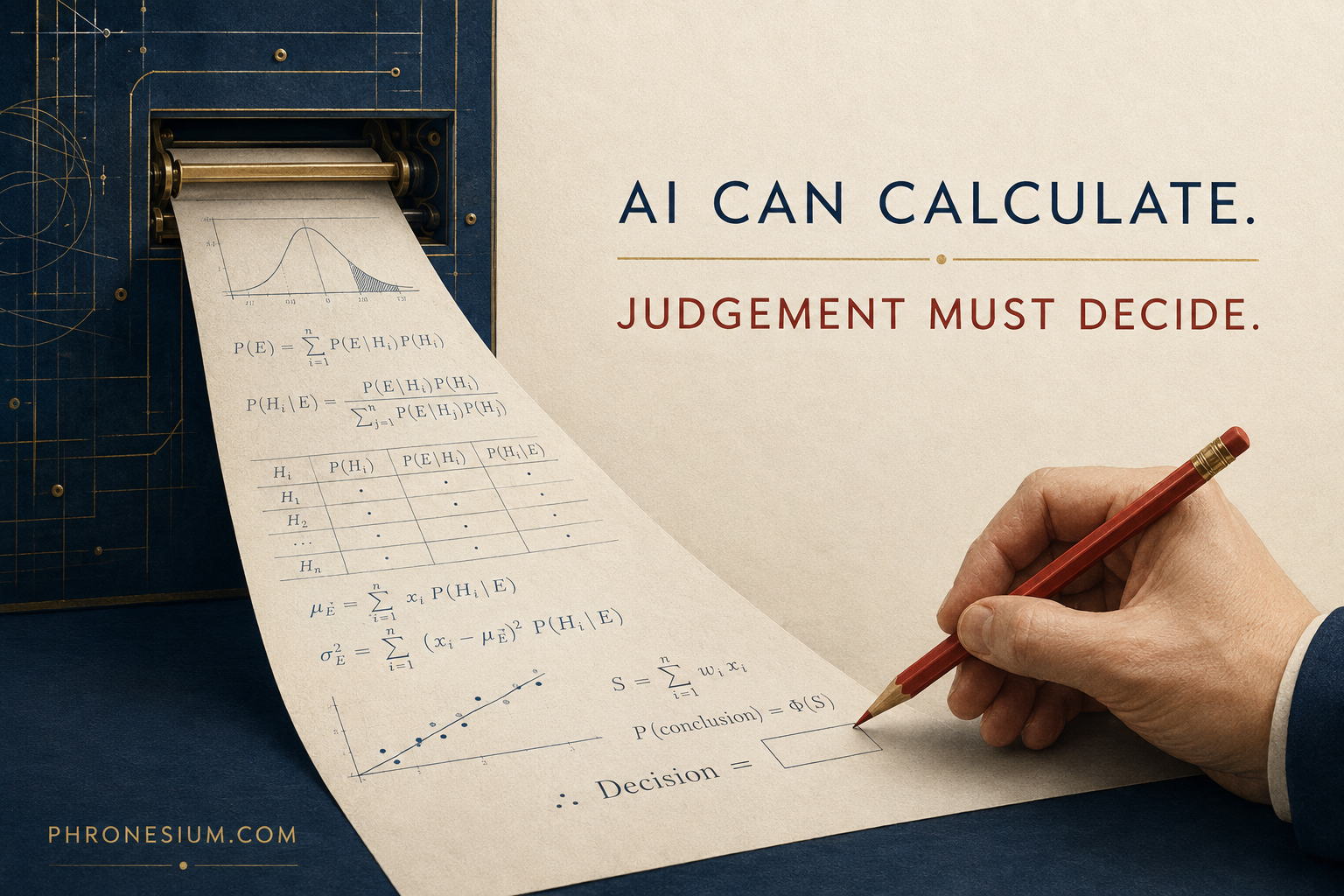
AI Can Calculate. Judgement Must Decide.
The machine on the left has done what machines do best. It has calculated probabilities, produced graphs and filled a long sheet with equations. It looks impressive. Length often helps.
Then it reaches the final box.
It stops.
The red pencil represents human judgement. Someone must decide what the numbers mean, which risks matter and what should happen next. The machine can analyse the evidence. It cannot choose the purpose, weigh the human consequences or accept responsibility when the decision goes wrong.
This is the central message of Phronesium. Information matters. Analysis matters. AI will make both faster.
But a faster calculation is not necessarily a better decision.
AI can bring us to the final box.
Judgement must fill it.
A number is not a decision
Fry tells the story of a patient facing cancer treatment.
Without further treatment, the patient had an estimated 84 per cent chance of surviving another ten years. With chemotherapy, radiotherapy and hormone therapy, the figure increased to 88 per cent.
Eighty-eight is higher than eighty-four. So the answer seems obvious.
Except it is not.
Treatment has consequences. It may extend life. It may also make part of that life extremely difficult. The figures measure survival. They do not fully measure pain, exhaustion, time with family or the quality of the years that remain.
The numbers matter. They simply do not settle the matter.
This is where many decisions begin to go wrong. We confuse what can be measured with what matters. A percentage looks precise. Human values look inconveniently vague.
But precision can create an illusion. A number may be accurate and still fail to answer the real question.
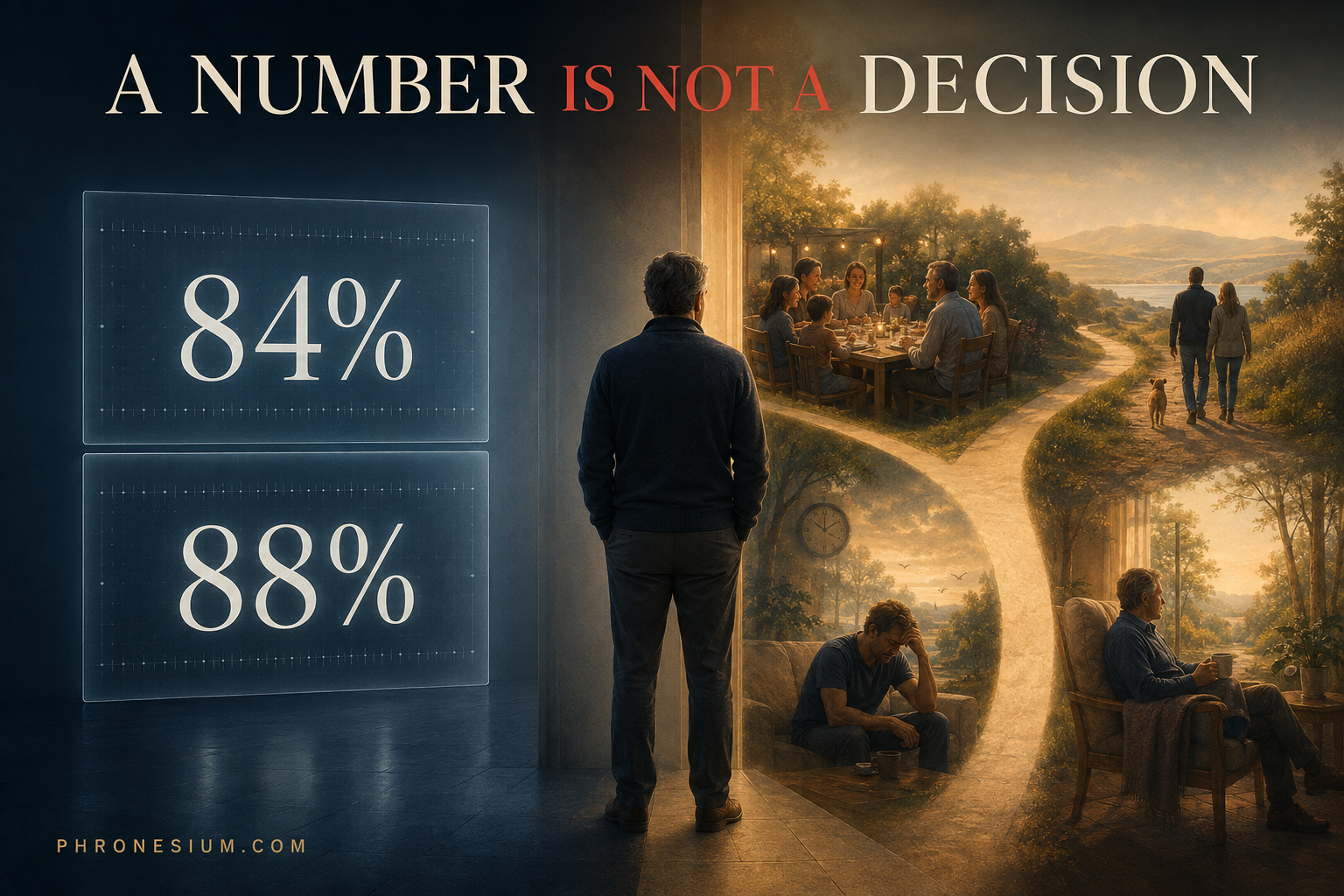
The image places two precise figures—84 per cent and 88 per cent—against the untidy reality of human life.
On paper, the choice appears simple. Eighty-eight is higher than eighty-four. Mathematics has spoken. Everyone may now go home.
Except the figures measure only one thing: the probability of survival. They do not measure pain, exhaustion, difficult months of treatment, time with family or the quality of the years that remain. These things are harder to place in a chart. This does not make them less important.
The image therefore shows the limit of precision. Numbers can describe part of a decision with impressive accuracy while remaining silent about the part that matters most.
This is not an argument against evidence. The percentages matter. But they cannot tell the patient what kind of life is worth choosing.
That requires values, context and judgement.
A number can inform the decision. It should not be allowed to impersonate one.
What are we actually trying to achieve?
Hoffman asks the question that should come before every calculation: what are we trying to optimise?
It sounds obvious. In practice, it is often forgotten.
A hospital may optimise survival rates. A school may optimise examination results. A business may optimise quarterly profit. A social media platform may optimise engagement.
Each measure tells us something useful. But each can quietly replace the purpose it was meant to support.
A school can improve grades without improving education. A prison system can process offenders efficiently without reducing crime. A dating app can produce millions of matches without helping many people build lasting relationships.
The system works perfectly. The result is still wrong.
Before asking whether a process is efficient, we should ask whether it is pursuing the right end. Moving faster is not much help if we have chosen the wrong road.
Probability does not remove responsibility
Most of us are uncomfortable with uncertainty.
We hear an 88 per cent probability and quietly translate it into yes. We hear 12 per cent and treat it as no. Then the unlikely event happens and we feel that the statistics have let us down.
They have not. Probability never promised certainty.
It describes what may happen across many cases. It cannot tell one person exactly what will happen to them. It certainly cannot decide how much risk that person should accept.
Two people may look at the same evidence and make different choices. Both may be reasonable. Their health, responsibilities, priorities and tolerance for risk may not be the same.
Good judgement does not make uncertainty disappear. It recognises uncertainty and still reaches a decision that can be explained and defended.
That is harder than quoting a percentage. It is also more honest.
AI can be wrong very convincingly
The conversation becomes particularly relevant when it turns to AI.
Hoffman makes a useful distinction. AI systems are often good at broad questions. Ask for seven common principles of entrepreneurship and the answer may be perfectly helpful. Ask about an obscure fact, an exact quotation or an unusual event and the risk of invention increases.
Being wrong is not unique to AI. Human beings were doing it long before electricity.
The problem is that AI can be wrong so fluently.
It can produce a detailed, polished and plausible answer without the hesitation a sensible person might show. The tone is confident. The foundations may not be.
Fry points to systems such as AlphaFold, which show how confident the model is in different parts of an answer. That helps users see where the system is on familiar ground and where it may be struggling with an edge case.
Useful? Certainly.
Enough? No.
A model can be confident and still be wrong. Its data may be incomplete. The question may be badly framed. The case may be unusual. And even a rare error matters when the consequences are serious.
Accuracy is important. The cost of error matters too.
Not every answer deserves the same trust
The sensible response is not to trust AI completely. Nor is it to distrust everything it produces.
We need to know when to rely on it, when to challenge it and when to check the evidence ourselves.
Before using an AI-generated answer, I would ask six questions:
Is the question broad or highly specific?
Is this a routine case or an unusual one?
Can the answer be checked against reliable evidence?
What assumptions sit behind it?
What happens if it is wrong?
Who remains responsible for the decision?
The final question is the most important.
An organisation may use AI to analyse evidence, find patterns and suggest options. On some tasks it may outperform an individual expert. But responsibility does not pass to the machine.
“The algorithm recommended it” tells us how the answer appeared. It does not tell us why the decision was sound.
Start with what humans do badly
Fry also discusses an early approach to autonomous vehicles.
The machine would drive until something went wrong. At that point, the human was expected to notice the danger and intervene immediately.
There was one rather obvious flaw.
People are not good at watching a machine do nothing for long periods. We become distracted. We are also not at our best when control is suddenly returned during an emergency.
The design expected humans to be strongest at exactly the moment they were most likely to fail.
A better approach starts with a more honest question: what are people bad at, and where can the machine help?
Collision-warning and avoidance systems follow this logic. The driver remains involved. The technology monitors conditions, spots danger and compensates for predictable human lapses.
The same principle applies elsewhere.
AI should not be added to a process simply because somebody has bought a licence. It should be used where it improves the decision as a whole. That requires an honest view of both human weakness and machine weakness.
Neither side is infallible. The trick is to avoid arranging them so that one amplifies the faults of the other.
Audit should pay attention
The implications for audit, risk and governance are immediate.
AI can review entire populations of transactions. It can compare documents, identify anomalies and produce a first draft of an audit finding before the auditor has found last year’s template.
All of this is useful.
But an anomaly is not automatically a risk. Correlation is not cause. A complete dataset does not guarantee a complete understanding. And a polished paragraph is not necessarily a sound conclusion.
The auditor must still ask:
Is the evidence reliable?
What is the context?
Which assumptions drive the result?
What information may be missing?
Does the conclusion reflect the real risk?
What decision does management now need to make?
AI may speed up the analysis. It cannot accept professional responsibility for the conclusion.
Good governance therefore requires more than an AI policy. It requires clear accountability, proper challenge, standards for evidence, escalation routes and continued monitoring for bias and error.
A policy can describe the rules. It cannot exercise judgement when the awkward case arrives.
And the awkward case always arrives.
Better questions may matter more than better answers
One of Fry’s strongest observations concerns persuasion.
Facts and statistics rarely change a deeply held view on their own. People interpret evidence through experience, identity, fear and trust. Giving them another graph may simply give them another reason to stop listening.
Fry argues that we should listen first. Not listen while preparing our reply. Actually listen.
What experience sits behind the person’s position? What are they afraid of? What do they believe is at stake?
This is also an area where AI may help. A system that asks patient and relevant questions may sometimes encourage reflection better than a person determined to win the argument.
The idea is Socratic. People are more likely to reconsider a belief when good questions help them examine it for themselves.
The same is true in audit.
We do not improve a finding by burying management under more facts. Challenge becomes useful when it exposes an assumption, clarifies a consequence or shows that the stated objective and the actual behaviour do not match.
Better questions do not merely produce better answers. They improve the thinking that comes before the answer.
Make it stand out
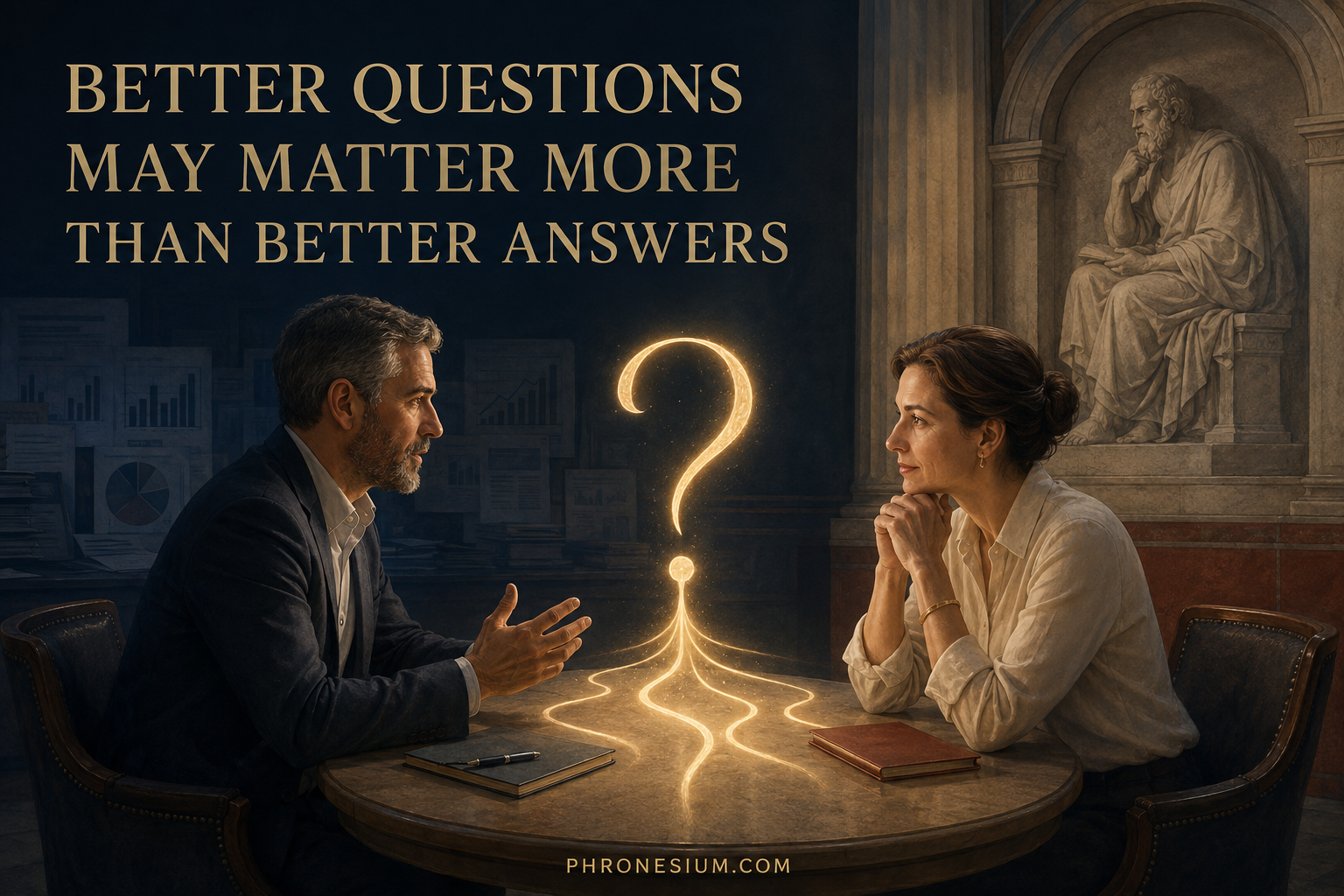
The image contrasts two ways of approaching a difficult conversation.
At the table, one person speaks while the other listens. Not the modern form of listening, where we remain silent only because it is not yet our turn. She is trying to understand what lies behind the other person’s position.
The question mark between them represents the space where better thinking begins. A good question can reveal an assumption, uncover a fear or show that two people are trying to solve different problems. It does not force an answer. It helps the other person examine their own reasoning.
Socrates watches from the background. He understood that people rarely improve their thinking because someone gives them more information. They improve it when the right question makes weak reasoning difficult to defend.
This is equally true in audit. More evidence does not automatically create more influence.
Better questions do not merely lead to better answers. They improve the thinking that produces them.
Judgement remains the work
AI will become faster and more accurate. It may even become better at recognising when it is uncertain.
None of this removes the need for judgement. It makes judgement more important.
Someone still has to decide what outcome matters. Someone must separate confidence from truth, weigh probability against consequence and recognise when a standard answer is being applied to an exceptional case.
Someone must remain accountable for what happens next.
AI can calculate the probability.
It can organise the evidence.
It can suggest an answer.
It cannot decide what matters.
That part remains ours.
This article was inspired by Hannah Fry’s conversation with Reid Hoffman and Aria Finger on the Possible podcast: Hannah Fry on AI, Algorithms, and Human Nature
