

What Socrates can teach us about thinking with machines
AI GIVES US ANSWERS. JUDGEMENT STILL REQUIRES QUESTIONS.
There is something dangerously satisfying about asking AI a question.
You type a few words. Sometimes a few paragraphs.
Almost immediately, an answer appears.
It is structured. Confident. Usually well written.
And very often we do something rather unwise.
We stop.
The more I use AI, the more I suspect that one of the most important skills in working with it has surprisingly little to do with technology.
It is the ability to ask another question.
What are you assuming?
What evidence supports this?
What else could be true?
What would somebody who disagrees say?
What would have to change for the conclusion to change?
More than two thousand years before ChatGPT, Socrates had already built an intellectual method around questions like these.
A fascinating 2023 paper by Edward Y. Chang, Prompting Large Language Models With the Socratic Method, made me think about what happens when we apply that ancient discipline to a very modern machine.
The result is this new Phronesium visual essay.
Not a guide to finding the perfect prompt.
Something slightly different.
A guide to not being satisfied with the first answer.
And, ultimately, to using AI without surrendering the one thing we should probably keep for ourselves:
judgement.
AI can answer. The more interesting question is what you ask next.
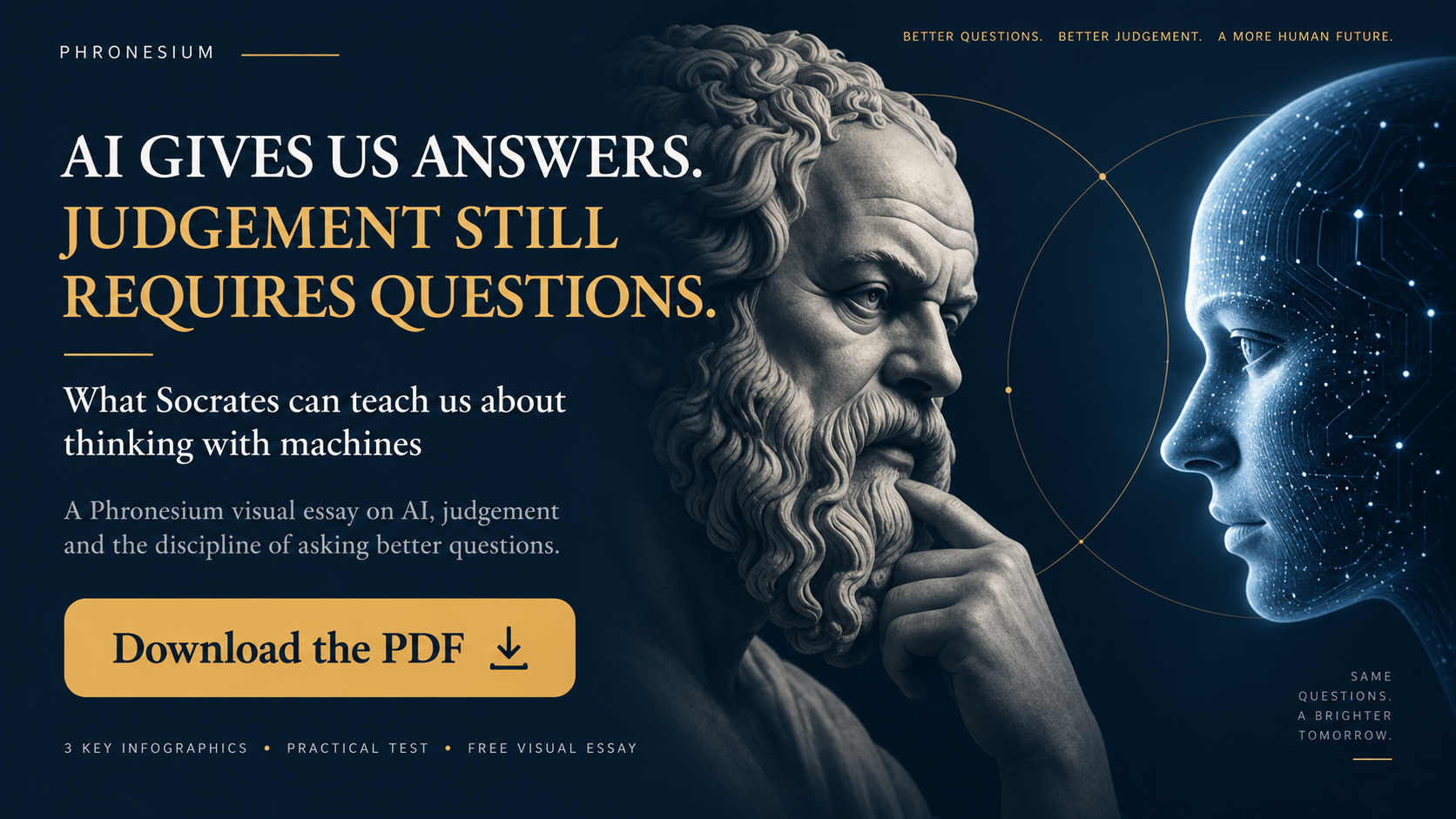
INSIDE THE VISUAL ESSAY
Better questioning, not better prompting.
Why the first AI answer should begin the inquiry rather than end it.
AI as a judgement partner, not an authority.
How AI can challenge assumptions and expose alternatives—without becoming evidence.
A practical Socratic method.
A simple sequence you can use to test conclusions, counterarguments, alternative explanations and uncertainty.
Small source note
This visual essay was inspired by and develops practical implications from Edward Y. Chang (2023), Prompting Large Language Models With the Socratic Method, arXiv:2303.08769. Full source and acknowledgement details are included in the publication.
