

Every Audit Leads to Philosophy
There is a curious game on Wikipedia.
Choose almost any article. Click the first meaningful link in its main text. Then repeat the process on each page that follows.
Historically, around 97% of these journeys ended in the same place:
Philosophy.
Changes to Wikipedia’s links have since disrupted the pattern. Yet the idea remains revealing. When we keep asking what something means, how it is defined and what lies beneath it, we eventually reach first principles.
Audit follows a similar path.
Begin with a failed control.
Follow it to a weak process.
Follow the process to a management decision.
Follow the decision to an assumption.
Follow the assumption far enough, and we arrive at a philosophical question:
How do we know that what we believe is true?
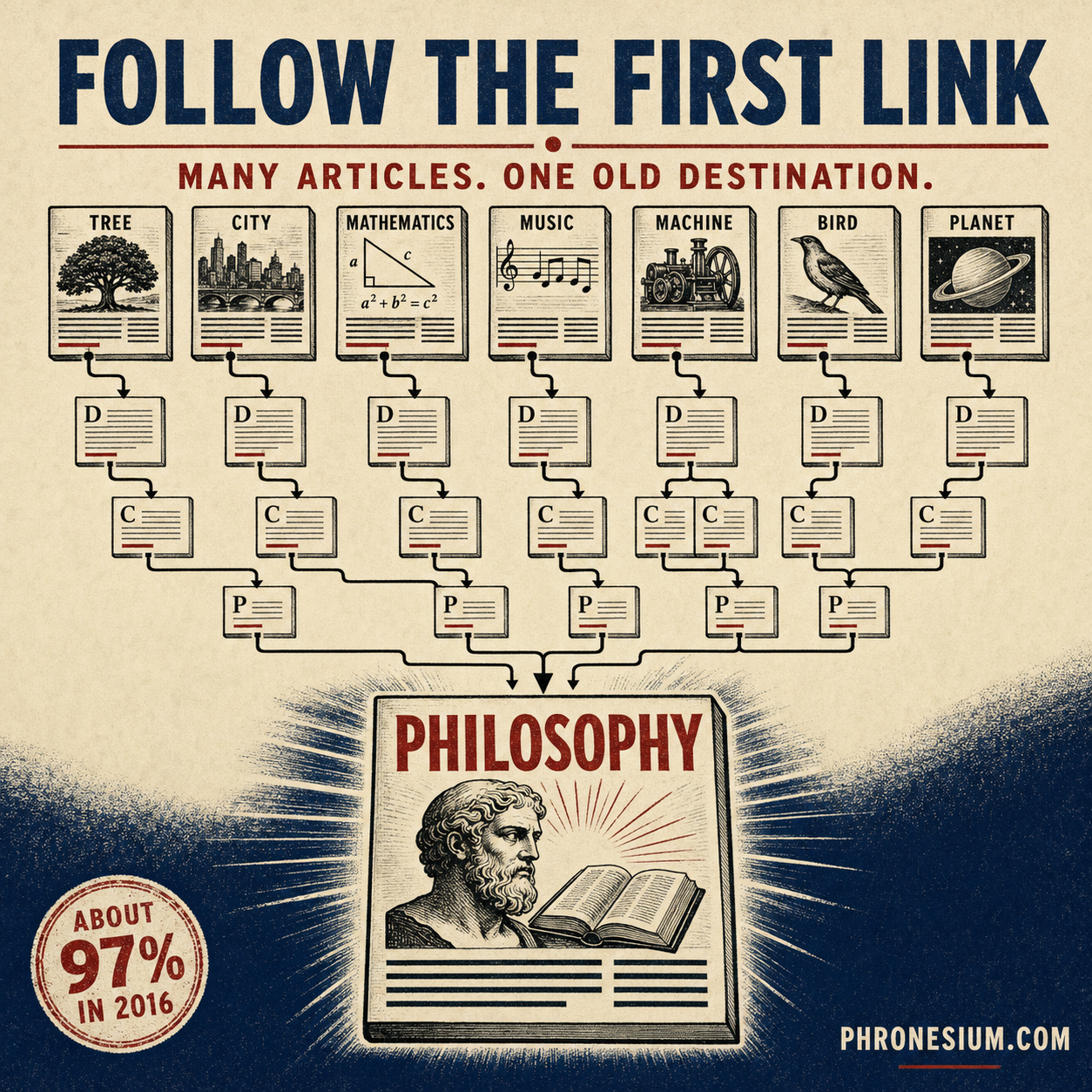
The image illustrates Wikipedia’s historic “Getting to Philosophy” phenomenon.
Articles on unrelated subjects—from nature and cities to mathematics, music and science—are connected through a chain of links. As each path moves through broader definitions and classifications, the routes gradually converge on one destination: philosophy.
In 2016, around 97% of Wikipedia articles reportedly led there when users repeatedly followed the first meaningful link. The image captures the deeper lesson behind this curious game: if we keep asking what something means and what lies beneath it, we eventually reach first principles.
The philosophy hidden inside every audit
Auditors practise philosophy more often than they realise.
When we ask whether evidence is sufficient, we are dealing with epistemology: the study of knowledge.
When we test whether a conclusion follows from the evidence, we are using logic.
When we consider what is fair, responsible or right, we enter the field of ethics.
When we decide what matters and what should be done, we exercise practical wisdom—or phronesis.
This is where philosophy and Phronesium meet.
Phronesium was founded on a simple belief: better decisions begin with better thinking. Audit is one of the places where that belief matters most.
Evidence does not speak for itself
A weak audit gathers information.
A good audit tests it.
A great audit examines the reasoning that connects the information to the conclusion.
Two auditors may examine the same documents and reach different views. They may begin with different assumptions, interpret risk differently or give different weight to the evidence.
The real work therefore sits between two statements:
“This is what we found.”
and:
“This is what it means.”
That space is called judgement.
Judgement cannot be reduced to a checklist. It must be informed by evidence, disciplined by logic and guided by experience.
Critical reasoning protects us from attractive mistakes
A polished dashboard can be wrong.
A confident executive can be mistaken.
A familiar process can still be badly designed.
A control can operate exactly as intended while addressing the wrong risk.
Critical reasoning encourages auditors to ask:
Does the conclusion really follow from the evidence?
Are we confusing correlation with cause?
Are we generalising from a small or unusual sample?
Are we treating the absence of incidents as proof that the control works?
Have we looked for evidence that challenges our first impression?
What would make us change our conclusion?
These are not academic questions. They shape audit scopes, findings, ratings and reports.
A logical error in a classroom may lose a mark.
A logical error in an audit may give false assurance to a board.
Professional scepticism is philosophy at work
Socrates became famous not for pretending to possess every answer, but for questioning what people believed they knew.
The good auditor does something similar.
Not because management must be wrong.
Not because every document must be false.
But because confidence is not evidence, repetition is not proof and seniority does not make an assumption true.
Professional scepticism is philosophy in working clothes. It asks us to remain curious, test the reliability of information and investigate what appears incomplete, inconsistent or too convenient.
The question is not merely:
“Can this be supported?”
It is also:
“What might we be missing?”
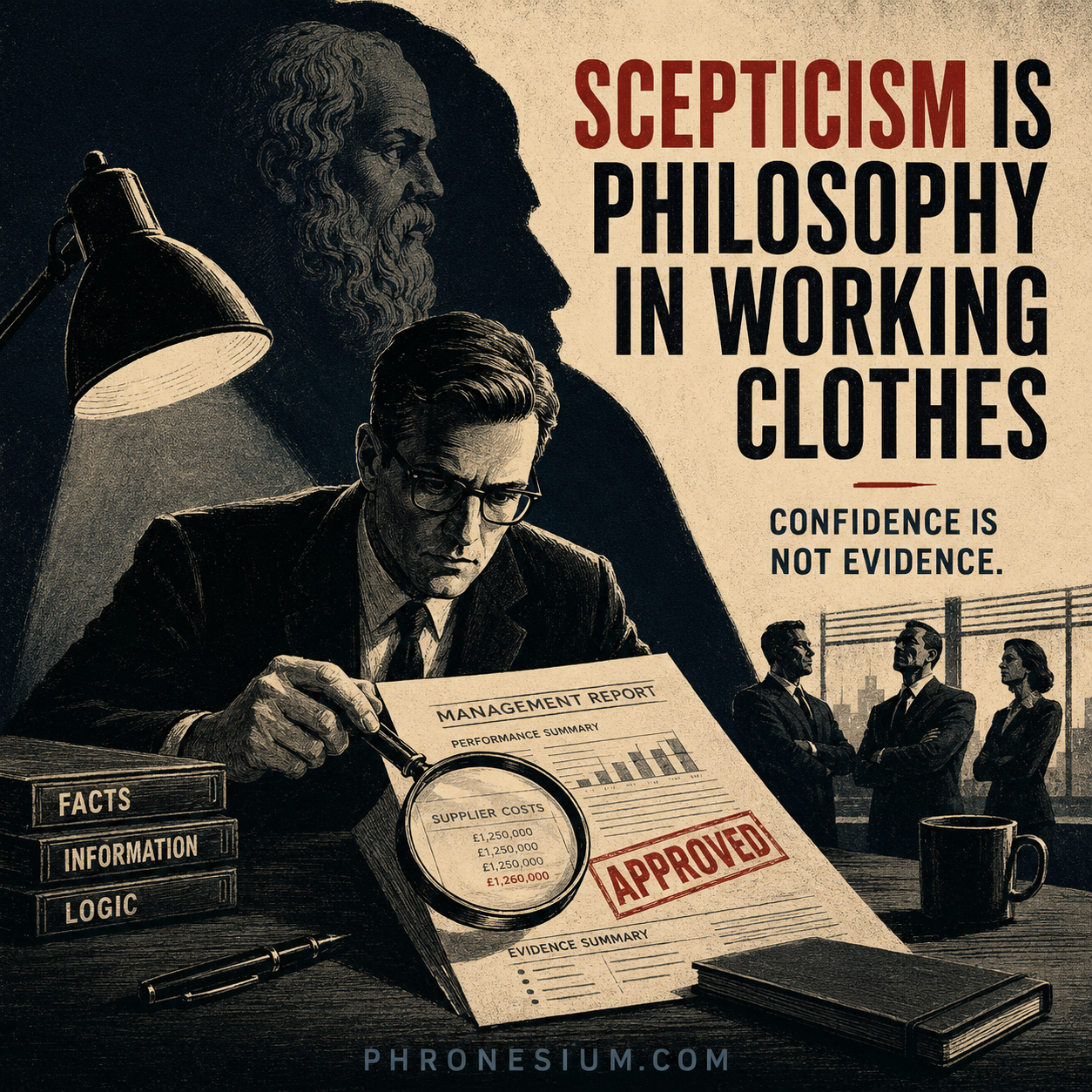
The image shows what professional scepticism means in practice.
The auditor is reviewing a management report. The document is marked “Approved,” but he does not accept it only because other people have already approved it. He uses a magnifying glass to check the figures and discovers that something is not correct.
Behind him, we can see Socrates. He represents the importance of asking questions and not believing that we already know everything.
The books called Facts, Information and Logic show what should support an auditor’s judgement.
The message is simple: scepticism does not mean that we do not trust people. It means that we check the evidence before reaching a conclusion.
Confidence is not evidence. Approval is not proof.
Ethics begins where the checklist ends
Logic asks:
Is this conclusion sound?
Ethics asks:
What should we do about it?
An auditor may face pressure to soften a finding, narrow a conclusion or overlook an uncomfortable fact. No spreadsheet can decide what courage requires. No methodology can remove the need for moral judgement.
Rules help. Standards matter. But neither can anticipate every circumstance.
Sometimes an auditor must choose between being liked and being useful.
Between organisational comfort and professional honesty.
Between reporting what is easy to defend and reporting what stakeholders genuinely need to know.
That is more than compliance.
It is practical wisdom.
Why this matters even more in the age of AI
Technology can process enormous volumes of data. It can detect patterns, summarise documents and produce polished reports.
But it cannot relieve auditors of responsibility for deciding:
which questions should be asked;
which evidence can be trusted;
which risks genuinely matter;
whether a conclusion is fair;
and what should happen next.
The future of audit will not belong only to those with the most advanced tools.
It will belong to those who can ask the best questions.
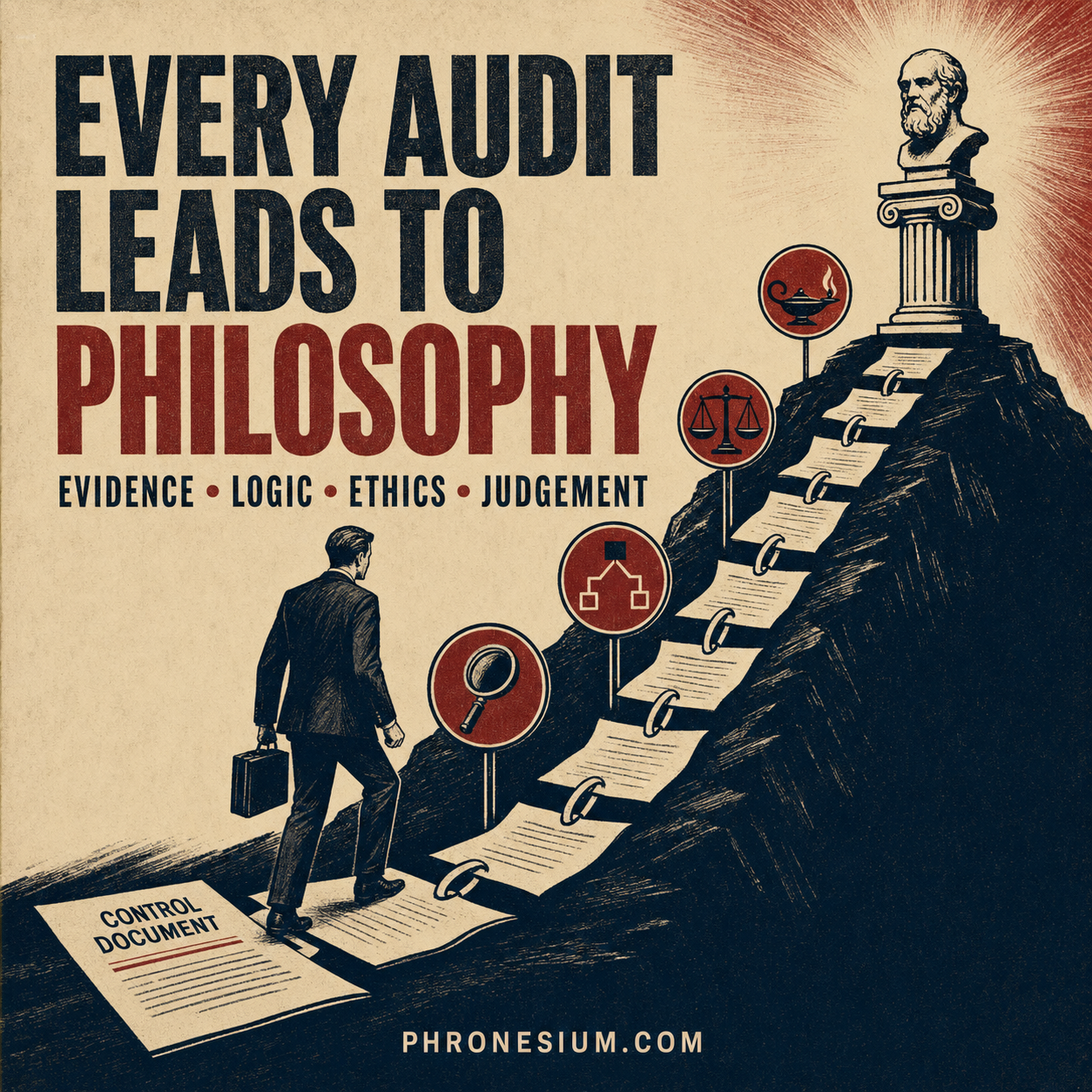
The Audit Beneath the Audit
Follow the evidence far enough, and you reach philosophy.
It begins with what the auditor can see: a control, a process or a piece of evidence. But good audit does not stop there. It follows the chain—questioning assumptions, testing reasoning and searching for what is true.
At the end of that journey stands philosophy, representing the four foundations of sound professional judgement: knowledge, logic, ethics and critical reasoning.
The message is simple: an auditor’s greatest tool is not the checklist, but the disciplined mind behind it.
Follow the evidence. Question the assumptions. Reach first principles.
The Phronesium view
At Phronesium, we see philosophy not as something remote from business, but as a practical discipline for improving professional judgement.
It gives auditors essential habits of mind:
curiosity before certainty;
evidence before confidence;
reasoning before conclusion;
dialogue before judgement;
courage before convenience;
wisdom before procedure.
Every audit begins somewhere: with a number, a control, an incident or a concern.
Follow the chain carefully enough, and we move from the visible problem to the hidden assumption. From the assumption, we reach questions of knowledge, logic, ethics and judgement.
In other words, we arrive at philosophy.
Perhaps that is not surprising.
Audit is a search for justified confidence in a world that rarely gives us certainty.
Philosophy teaches us what to do when the answer is not obvious:
Slow down. Define the question. Examine the evidence. Test the reasoning. Then decide.
That is not philosophy standing apart from audit.
That is philosophy doing the audit.
