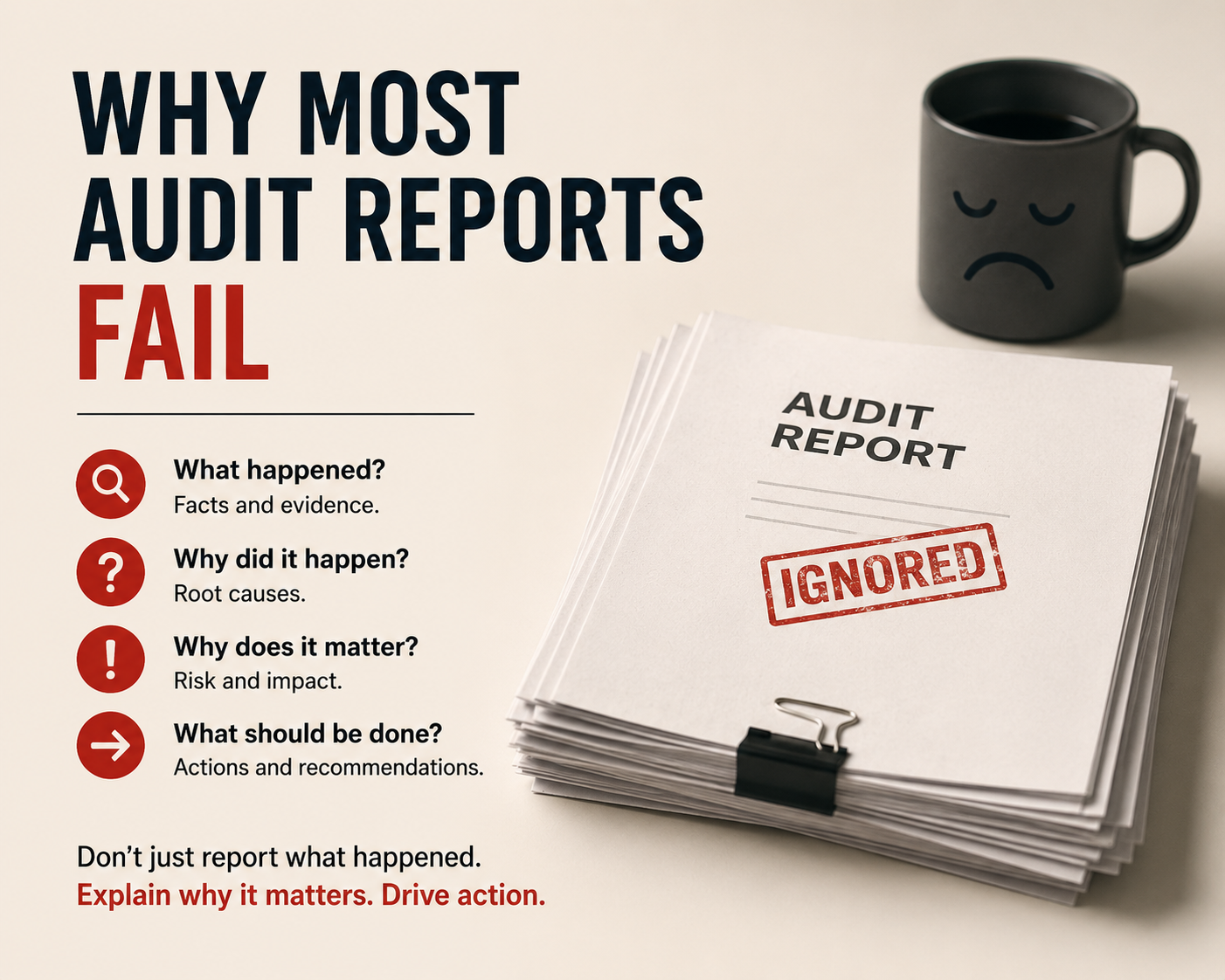
Why Most Audit Reports Fail
Most audit reports are technically correct.
Many are also ineffective.
They contain evidence, findings, recommendations, and management responses. Yet they fail to influence decisions.
The reason is simple.
They focus on what happened rather than why it matters.
Executives do not need a description of a control weakness. They need to understand the risk, the impact, and the consequence of inaction.
A good audit report answers four questions:
What happened?
Why did it happen?
Why does it matter?
What should be done?
The most important section is often the executive summary. If that section fails, the report fails.
An audit report should not merely communicate information.
It should change understanding.
And ultimately, it should drive action.
![]() A.C. Coppola
A.C. Coppola
A. C. Coppola has spent more than 20 years working in governance, audit and risk across over 20 countries. He founded Phronesium with a simple belief: knowledge is widely available, but sound judgement is harder to find. Better decisions begin with clearer thinking.